
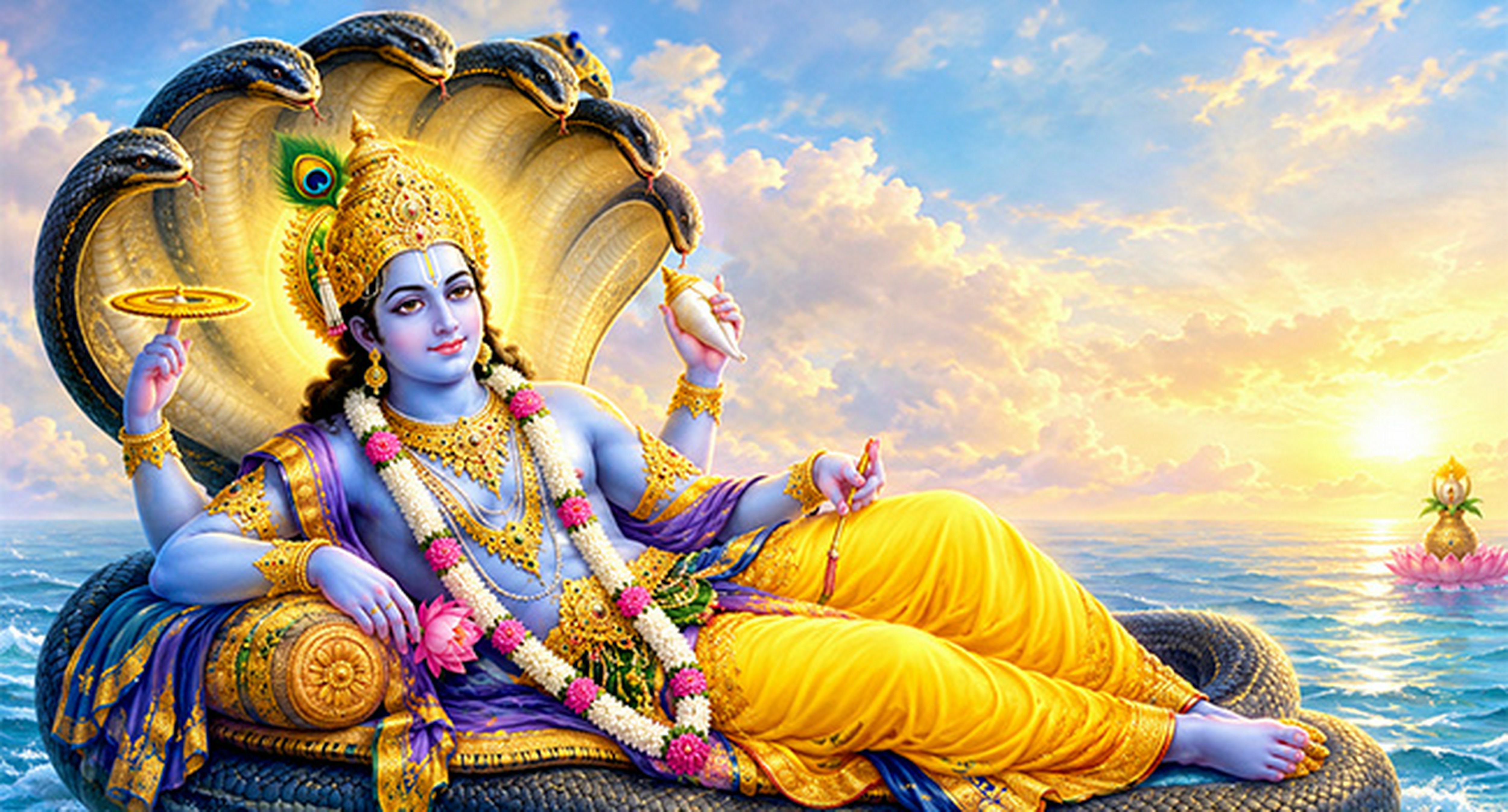
1008 Names of Lord Vishnu
In Hindu mythology, Lord Vishnu is the God of Preservation, often depicted very benevolently. He is part of the Holy Trinity in Hinduism, alongside Brahma and Shiva. Vishnu is prominent not only in Hinduism but also in other religions, or rather sub-religions within Hinduism, such as Vaishnavism. He is the supreme lord in Vaishnavism. He is the preserver, creator, and protector of the universe. Everything that was, is, and will be is under the control of Lord Vishnu. He is the absolute Brahman, the most perfect being, with limitless qualities transcending through space and time. When there was nothing in the universe, there was Vishnu; when there was nothing in this universe, there would be Vishnu. Everything that was and will be is assimilated within this Supreme Being.
Depictions of Lord Vishnu
Talking about visual representations, lord Vishnu, is often represented as a dark-skinned man, well-dressed, and wearing quite some jewelry. He has four hands, two representing his presence in the mortal realm and two representing his presence in the spiritual realm. His four hands hold a conch, a chakra, a club, and a lotus. In Vaishnavism, The club, Chakra, and conch are the holy weapons Vishnu uses to maintain peace and order in the universe. At the same time, the lotus represents life, reminding us that he destroys and preserves.
Lord Vishnu has both benevolent and malevolent forms depicted across texts. In his benevolent form, he is often depicted as a peace-loving, omniscient being sleeping peacefully within the coils of the serpent Sesha, representing time, accompanied by his consort, goddess Laxmi. The depiction of lord Vishnu sleeping within the coils of time makes it clear that he is above the laws of time. He doesn't age; he is limitless and transcendent; the whole world, universe, space, and time are all at his fingertips. Lord Vishnu has no such malevolent form; instead, he has several avatars. Whenever chaos and anarchy engulf the world, Lord Vishnu descends into the mortal realm as one of his ten avatars. This also tells us why he has been crowned the God of Preservation; whenever his creation is threatened, he ensures the threat is eliminated.
The Avatars of Lord Vishnu
Being the preserver of the universe, lord Vishnu has descended to the mortal realm several times to restore peace and order. The Dashavatara, or the ten avatars of lord Vishnu, depict the ten forms he has taken over time to rule over anarchy and bring peace to his creations. Some of his avatars, like Buddha, have become the symbols of other religions, Buddhism to be precise here. Although no proper text can be taken as a standard for noting the ten avatars of lord Vishnu, the most acceptable list is found in the Puranas.
Modern interpreters and historians have given new definitions to the existence of these ten avatars of lord Vishnu. The definition in question is of the evolutionary order of mankind. According to them, the ten avatars of Lord Vishnu represent the ten stages of the evolution of mankind. Following is a comprehensive list of all the avatars, their historical reference, and the stage of evolution they represent:
1. Matsya (Fish Avatar)
King Vaivasvata Manu was a very wealthy and powerful king who, one day, while performing his tarpan (water offering), found a small fish in his palm. This fish asked Manu whether he could give it a proper home. Manu took the fish home, but the fish kept expanding, and eventually, Manu had to release it into the ocean, only to realize it was Lord Vishnu himself. Vishnu warned Manu about the upcoming apocalypse (Pralaya) and directed him to collect all creatures of the world and put them in a boat built by the gods. Vishnu would then take the form of a huge fish with horns and take all the world's creatures away from destruction. The analogy of these events can be drawn from the contemporary events of Noah's Arc, where God directs Noah to build an arc and carry all the world's species away from the great flood. According to modern historians, this avatar of Lord Vishnu represents the Paleozoic era.
2. Kurma (Tortoise Avatar)
During the legend of Samudra Manthan, where gods were churning the sea of Milk to find Amrita, the nectar of immortality, they used the mountain Mandara and the churning Shaft. However, Mandara would soon start sinking from the enormous weight. Lord Vishnu then took the Kurma (Tortoise) form and held the mountain's weight, letting the gods finish their task. This avatar represents the Mesozoic era, according to modern historians.
3. Varaha (Boar Avatar)
When the gatekeepers of Vaikuntha, the abode of lord Vishnu, stopped the four Kumaras from seeing him, they cursed them. They were then reincarnated three times as asuras going against Vishnu. In one of the incarnations, they were the brothers Hiranyaksha and Hiranyakashipu. When Hiranyaksha abducted the earth and dragged it down to the bottom of the ocean, Lord Vishnu appeared as the Varaha avatar and fought with him. The battle lasted for a thousand years, and finally, Lord Vishnu appeared victorious and brought the earth back to the surface. This avatar is said to represent the Cenozoic era of human evolution.
4. Narasimha (Half Man/ Half Lion Avatar)
Hiranyakashipu persecuted all the human beings who followed religion or worshipped gods, including his son Prahlada. Prahlada was a devotee of Lord Vishnu, and upon seeing his devotee getting persecuted, he descended to the mortal realm, taking the anthropomorphic form of Narasimha (Half-man, half-lion). He disemboweled Hiranyakashipu and ended his persecution, thus saving all the humans, including Prahlada. This avatar of lord Vishnu is also said to depict the Cenozoic Era (preferably late Cenozoic Era).
5. Vamana (Dwarf Avatar)
With great devotion and perseverance, Bali, the grandson of Prahlada, defeated Indra, the King of heaven. Having done so, he had humbled numerous deities, who then sought refuge under Lord Vishnu. Lord Vishnu descended the mortal realm as a Vamana (dwarf). He approached Bali and, in a Yajna, asked for three paces of land. Bali agreed, and Vishnu then took a massive form. With one stride, he covered the earth's realm. He covered the realm of heaven with another stride, thus covering all mortal realms in just two strides. Bali realized that Vamana was Vishnu himself and offered his head as the third and last place for Vishnu to land his foot. Vishnu did so, making him immortal and the Ruler of the Netherworld. However, Vishnu also gave him a boon that every year, he would be able to visit the mortal realm. The festival of Onam, celebrated by the people of Kerala, is performed as a homecoming ritual of Bali, the Ruler of the Netherworld. The Vamana avatar of Lord Vishnu depicts the first steps of mankind toward civilization, according to modern historians.
6. Parashurama (Warrior Avatar)
Parashurama was the son of Jamadagni and Renuka and was bestowed with an axe from Lord Shiva due to his penance. When King Kartavirya Arjuna visited the Parashurama's home, his father could only see the King because of his divine cow Kamdhenu. The King wanted the cow for himself, and when Jamadagni refused, he took the cow by force and destroyed their home. Parashurama swore to take revenge and kill the King at his palace, destroying his army alone. The sons of the King then killed Jamadagni, and enraged by this, Parashurama took a vow to travel the world twenty-one times to kill every Kshatriya king. He could only be halted by his grandfather, the rishi Ricika. Parashurama is said to have created the coastal belts of Karnataka and Kerala by throwing his axe. Modern historians say that Parashurama is the depiction of the Stone Age man in the evolution of mankind.
7. Rama (The King of Ayodhya)
Rama is by far one of the most worshipped avatars of Lord Vishnu. Rama, his wife Sita, and brother Lakshmana were forced into exile from their kingdom, Ayodhya, due to a conspiracy. While in exile, Sita is abducted by the King of Rakshasas, Ravana, and taken to Lanka. Rama creates an army and travels to Lanka to kill Ravana and save his wife, Sita. After these events, they are welcomed to their kingdom and on the day of the return of Rama to Ayodhya. Rama embodies an ideal hero: a righteous man, a loving husband, and a great brother. According to modern historians, The avatar Rama of Lord Vishnu is the next step in the evolution of mankind from Stone Age man to a civilized and romantic human.
8. Krishna (The Eighth Avatar)
Alongside Rama, Krishna is also one of the most popular deities in Hindu Mythology. Krishna was the eighth son of Devaki and Vasudeva (a stark analogy to him being the eighth avatar of Lord Vishnu). While still an infant, he slayed his tyrannical uncle, Kamsa. He played a significant role in the Kurukshetra war as the charioteer of Arjuna. He also bestowed upon Arjuna the knowledge of Gita, which would then become the holy book of the Hindus. In certain texts, Balarama, Krishna's elder brother, is said to be the eighth avatar of Vishnu. Krishna embodies a God in a human, the perfect being, a superhuman.
9. Buddha (The Ninth Avatar)
The ninth avatar of Lord Vishnu, Buddha, is an enlightened man. He was the founder of Buddhism, a religion similar to Hinduism. In Hindu scriptures, Buddha is depicted as an enlightened man who leads the Asuras and heretics away from the path of the Vedas. He was also the teacher and preacher of the path of Ahimsa (non-violence). In certain regions or subcultures, Buddha is replaced by other beings like Vithoba in Goa or Jagannath in Odisha as the ninth avatar of Lord Vishnu. According to modern historians, this is the ultimate form that a human can take now, that of an enlightened man who has achieved Nirvana.
10. Kalki (The Final Avatar)
Kalki is the most fearsome avatar of Lord Vishnu and appears at the end of each Kali Yuga. He would come atop his white horse, his blazing sword drawn. He only appears when Dharma has disappeared, and the world plunges into chaos and anarchy. He destroys everything and creates the path for Satya Yuga, essentially resetting the existence cycle. Human civilization has yet to reach this stage but crawls toward it. At the end of civilization, when there is nothing left for humans, Kalki will appear and reset the cycle of evolution.
Vishnu Sahashranama
A being deemed the universe's creator, destroyer, and preserver can never have a single name. Everyone chants the name Vishnu, but Lord Vishnu has been given hundreds of names in Vedas and Puranas throughout the ages. One thousand and eight names, to be precise. These names are all listed in the Sanskrit hymn Vishnu Sahashranama.
1. The Origin of the Vishnu Sahashranama
The first and the most significant reference to the 1008 names of Vishnu is found in the 135th chapter of Anushasanaparva (verses 14 to 120) in Mahabharata. During the battle of Kurukshetra, when the grandsire and warrior of the Kuru dynasty, Bhishma, had been impaled by several arrows and was lying on the battlefield, waiting for death, Yudhishthira approached him and asked a few questions regarding the existence and the truth about the world. Yudhishthira had asked Bhishma, and we quote:
“In this world, Who is the one refuge for all? Who is the greatest Divinity in the world? By eulogizing whom can a person reach auspiciousness? By worshipping whom can a person reach auspiciousness? What is, in your opinion, the greatest Dharma among all the Dharmas? By chanting whose name can a creature proceed beyond the bonds of samsara?”
In reply, on his deathbed, Bhishma had said that there is only one hymn, worshipping which we mortal beings can rid ourselves of all our sins, sorrows, and sufferings, and that hymn is the Vishnu Sahasranama. Bhishma also mentioned that Vishnu Sahasranama is the compilation of all the 1008 names of Lord Vishnu, the universe's creator, preserver, and destroyer. Everything, animate or inanimate, lies within him, and he, in return, is present in every molecule of existence. Vishnu is the ultimate Brahman in this universe. In the 148th chapter of Anushasanaparva, Bhishma starts chanting the Vishnu Sahashranama hymn, and chapter 149 (verses 14 to 120) holds the prime part, that is, the 1008 names of Lord Vishnu. According to Hindu Philosophy, Brahman is the ultimate form of existence in this universe, which is all-pervasive, eternal and the final truth of everything known and unknown. Brahman is immaterial, formal, and the final reason behind everything. Such is the significance of the existence of lord Vishnu, and such is the importance of the Vishnu Sahashranama.
Yudhishthira had approached Lord Krishna (avatar of Lord Vishnu) to impart him with the same knowledge of Gita as had been imparted to Arjuna. However, Lord Krishna denied Yudhishthira's prayer and directed him towards Bhishma, who was already nearing death. Both lord Vishnu and Narada Muni trained Yudhishthira in the principles of Dharma and the true duties of a man. Being the eldest of the Pandavas and the rightful successor of the throne along with Duryodhan, was quite concerned with the true Dharma of a human being. That was the real reason he had approached Bhishma. Having admitted defeat, Bhishma said that chanting the 1008 names of Lord Vishnu would rid a person of all their sorrows and sufferings and recite them himself.
2. The Significance of the Vishnu Sahashranama
The Vishnu Sahasranama is one of the most popular texts among the Hindus and the most important for the Vaishnavas since Vishnu is their supreme god. In certain verses, names such as “Shiva,” “Shambhu,” and “Ishanah” that refer to lord Shiva are present, which translates to the fact that lord Vishnu is the Brahman itself and not any aspect or part of it. Followers and believers who recite the Vishnu Sahasranama daily say that it brings great peace of mind, rid it of any kind of stress, and brings eternal knowledge.
Some of the key benefits of reciting this hymn are as follows:
● Keeping negativity at bay
Followers and devotees who chant the 1008 names of Lord Vishnu regularly have admitted that all their sorrows, sufferings, and any form of negativity affecting their lives have been completely removed.
● Gaining positive traits
When a person recites the Vishnu Sahshranama with utmost faith and devotion, he/she is bestowed with huge wealth, a healthy life, a good reputation, and a strong sense of righteousness and inner peace.
● Removal of diseases
It is believed that chanting the Vishnu Sahashranama gives off a vibrant energy that cleanses one's body and mind, effectively removing all sorts of diseases and ailments. The chanting must be done with full devotion and faith.
1008 names of Lord Vishnu
Having explored the origin and truth behind the Vishnu Sahashranama, we now indulge ourselves in reciting and chanting all the 1008 names of Lord Vishnu:
1. Vishvam (विश्वम्): The Universe (विश्व)
2. Vishnuh (विष्णुः): The All-Pervading One (विष्णु)
3. Vashatkaarah (वषट्कारः): The One Who is invoked for Oblations (वषट्कार)
4. Bhootabhavyabhavatprabhuh (भूतभव्यभवत्प्रभुः): The Lord of Past, Present, and Future (भूतभव्यभवत् प्रभु)
5. Bhootakrit (भूतकृत्): Creator of All Beings (भूतकृत)
6. Bhootabhrut (भूतभृत्): The Sustainer of All Beings (भूतभृत)
7. Bhavah (भावः): Existence Itself (भाव)
8. Bhootaatma (भूतात्मा): The Soul of All Beings (भूतात्मा)
9. Bhootabhavana (भूतभावनः): He Who Nourishes All Beings (भूतभावन)
10. Pootaatma (पूतात्मा): The Purest Soul (पूतात्मा)
11. Paramaatma (परमात्मा): The Supreme Soul (परमात्मा)
12. Muktanam Paramaa Gatih (मुक्तानां परमा गतिः): The Ultimate Goal for the Liberated Souls (मुक्तानां परमा गतिः)
13. Avyayah (अव्ययः): Imperishable (अव्यय)
14. Purushah (पुरुषः): The Cosmic Being (पुरुष)
15. Saakshi (साक्षी): The Witness (साक्षी)
16. Kshetrajnah (क्षेत्रज्ञः): Knower of the Field (क्षेत्रज्ञ)
17. Aksharah (अक्षरः): Indestructible (अक्षर)
18. Yogah (योगः): Yoga (योग)
19. Yogavidam Neta (योगविदां नेता): Guide of the Yogis (योगविदां नेता)
20. Pradhanapurusheshvarah (प्रधानपुरुषेश्वरः): The Supreme Controller of the Primal Being (प्रधानपुरुषेश्वर)
21. Narasimhavapuh (नारसिंहवपुः): The One with the Body of Man and Lion (नरसिंहवपु)
22. Shreeman (श्रीमान्): The Glorious (श्रीमान)
23. Keshavah (केशवः): The Slayer of Keshi (केशव)
24. Purushottamah (पुरुषोत्तमः): The Supreme Divine Personality (पुरुषोत्तम)
25. Sarvah (सर्वः): The All-Encompassing (सर्व)
26. Sharvah (शर्वः): The Auspicious (शर्व)
27. Shivah (शिवः): The Auspicious One (शिव)
28. Sthanuh (स्थाणुः): The Unmoving (स्थाणु)
29. Bhootaadiah (भूतादिः): The Source of All Elements (भूतादि)
30. Nidhiravyayah (निधिरव्ययः): The Imperishable Treasure (निधिरव्यय)
31. Sambhavah (सम्भवः): The Source of Birth (सम्भव)
32. Bhavanah (भावनः): He Who Nurtures All Beings (भावन)
33. Bharta (भर्ता): The Sustainer (भर्ता)
34. Prabhavah (प्रभवः): The Source (प्रभव)
35. Prabhuh (प्रभुः): The Lord (प्रभु)
36. Eeshvarah (ईश्वरः): The Supreme God (ईश्वर)
37. Swayambhoo (स्वयम्भूः): Self-Existent (स्वयम्भू)
38. Shambhoo (शम्भुः): Abode of Joy (शम्भु)
39. Aadityah (आदित्यः): The Son of Aditi (आदित्य)
40. Pushkaraakshah (पुष्कराक्षः): Lotus-Eyed (पुष्कराक्ष)
41. Mahaasvanah (महास्वनः): Having a Thundering Sound (महास्वन)
42. Anadinidhanah (अनादि-निधनः): Beginningless and Endless (अनादि-निधन)
43. Dhaataa (धाता): The Supporter (धाता)
44. Vidhaataa (विधाता): The Ordainer (विधाता)
45. Dhaaturuttamah (धातुरुत्तमः): The Supreme Resting Place (धातुरुत्तम)
46. Aprameyah (अप्रमेयः): Incomprehensible (अप्रमेय)
47. Hrishikeshah (हृषीकेशः): Master of the Senses (हृषीकेश)
48. Padmanaabhah (पद्मनाभः): The Lotus-Naveled Lord (पद्मनाभ)
49. Amaraprabhuh (अमरप्रभुः): The Lord of Immortals (अमरप्रभु)
50. Vishvakarmaa (विश्वकर्मा): The Creator of the Universe (विश्वकर्मा)
51. Manuh (मनुः): The Descendant of Manu (मनु)
52. Tvashthaa (त्वष्टा): The Artisan (त्वष्टा)
53. Sthavishthah (स्थविष्ठः): The Most Glorious (स्थविष्ठ)
54. Sthavirah Dhruvah (स्थविरो ध्रुवः): Immutable and Eternal (स्थविरो ध्रुव)
55. Agrahyah (अग्राह्यः): Beyond Comprehension (अग्राह्य)
56. Shaashvatah (शाश्वतः): The Eternal (शाश्वत)
57. Krishnah (कृष्णः): The Dark-Complexioned Lord (कृष्ण)
58. Lohitaakshah (लोहिताक्षः): Red-Eyed (लोहिताक्ष)
59. Pratardanah (प्रतर्दनः): The Destroyer (प्रतर्दन)
60. Prabhootas (प्रभूतस्): The All-Pervading Lord (प्रभूतस्)
61. Trikakubdham (त्रिकाकुब्धाम): Having Three Steps (त्रिकाकुब्धाम)
62. Pavitram (पवित्रम्): The Purifier (पवित्र)
63. Mangalam-Param (मंगलं-परम्): The Supreme Auspiciousness (मंगलं-परम्)
64. Eeshanah (ईशानः): The Ruler (ईशान)
65. Pranadah (प्राणदः): Giver of Vital Energy (प्राणद)
66. Pranah (प्राणः): The Life Force (प्राण)
67. Jyeshthah (ज्येष्ठः): The Eldest (ज्येष्ठ)
68. Shreshthah (श्रेष्ठः): The Most Glorious (श्रेष्ठ)
69. Prajapatih (प्रजापतिः): Lord of All Creatures (प्रजापति)
70. Hiranyagarbhah (हिरण्यगर्भः): The Golden Womb (हिरण्यगर्भ)
71. Bhoogarbhah (भूगर्भः): The Source of Earth (भूगर्भ)
72. Madhavah (माधवः): Consort of Ma (माधव)
73. Madhusudanah (मधुसूदनः): Slayer of the Demon Madhu (मधुसूदन)
74. Eeshvarah (ईश्वरः): The Supreme Lord (ईश्वर)
75. Vikramee (विक्रमी): The Valiant (विक्रमी)
76. Dhanvee (धन्वी): The Archer (धन्वी)
77. Medhaavee (मेधावी): The Wise (मेधावी)
78. Vikramah (विक्रमः): The Prolific (विक्रम)
79. Kramah (क्रमः): The Stepper (क्रम)
80. Anuttamah (अनुत्तमः): The Incomparable (अनुत्तम)
81. Duraadharshah (दुराधर्षः): Unassailable (दुराधर्ष)
82. Kritajnah (कृतज्ञः): The Knower of All Deeds (कृतज्ञ)
83. Kritih (कृतिः): The Creator (कृति)
84. Atmavaan (आत्मवान्): The Self-Existent (आत्मवान)
85. Sureshah (सुरेशः): The Lord of the Devas (सुरेश)
86. Sharanam (शरणम्): The Refuge (शरण)
87. Sharm (शर्म): The Comforter (शर्म)
88. Vishvaretah (विश्वरेताः): The Source of the Universe (विश्वरेता)
89. Prajaabhavah (प्रजाभवः): Origin of All Beings (प्रजाभव)
90. Aha (अहः): Time (अह)
91. Samvatsarah (संवत्सरः): Year (संवत्सर)
92. Vyaalah (व्याळः): The Surrounder (व्याळ)
93. Pratyayah (प्रत्ययः): Assurance (प्रत्यय)
94. Sarvadarshanah (सर्वदर्शनः): Omniscient (सर्वदर्शन)
95. Ajah (अजः): Unborn (अज)
96. Sarveshwarah (सर्वेश्वरः): The Supreme Lord (सर्वेश्वरः)
97. Siddhah (सिद्धः): Accomplished (सिद्धः)
98. Siddhih (सिद्धिः): Achievement (सिद्धिः)
99. Sarvadih (सर्वादिः): The Beginning of Everything (सर्वादिः)
100. Achyutah (अच्युतः): Infallible (अच्युतः)
101. Vrishakapih (वृषाकपिः): Knower of All Entities (वृषाकपिः)
102. Ameyatma (अमेयात्मा): Immeasurable Soul (अमेयात्मा)
103. Sarva-yoga-vinisritah (सर्वयोगविनिसृतः): Source of All Yoga Systems (सर्वयोगविनिसृतः)
104. Vasuh (वसुः): Wealthy (वसुः)
105. Vasumanah (वसुमनाः): Charitable (वसुमनाः)
106. Satyah (सत्यः): Eternal Truth (सत्यः)
107. Samaatma (समात्मा): Equal to All (समात्मा)
108. Sammitah (सम्मितः): Self-Controlled (सम्मितः)
109. Samah (समः): Peaceful (समः)
110. Amoghah (अमोघः): Unfailing (अमोघः)
111. Pundarikakshah (पुण्डरीकाक्षः): Lotus-Eyed (पुण्डरीकाक्षः)
112. Vrishakarmah (वृषकर्मा): Performer of Excellent Deeds (वृषकर्मा)
113. Vrishakritih (वृषाकृतिः): Shaped Like a Bull (वृषाकृतिः)
114. Rudrah (रुद्रः): The Terrible (रुद्रः)
115. Bahushirah (बहुशिरः): Multi-headed (बहुशिरः)
116. Babhruh (बभ्रुः): The One with Complexion (बभ्रुः)
117. Vishvayonih (विश्वयोनिः): Source of the Universe (विश्वयोनिः)
118. Shuchishravah (शुचिश्रवाः): Praiseworthy (शुचिश्रवाः)
119. Amritah (अमृतः): Immortal (अमृतः)
120. Shashvatah-sthanuh (शाश्वतः-स्थाणुः): Ever-stable (शाश्वतः-स्थाणुः)
121. Vararohah (वरारोहः): Bestower of Boons (वरारोहः)
122. Mahatapah (महातपः): Of Great Penances (महातपः)
123. Sarvagah (सर्वगः): All-pervading (सर्वगः)
124. Sarvavid-bhanuh (सर्वविद्भानुः): All-knowing Sun (सर्वविद्भानुः)
125. Vishvak Senah (विष्वक्सेनः): Commander of the Celestial Army (विष्वक्सेनः)
126. Janardanah (जनार्दनः): Liberator of Humanity (जनार्दनः)
127. Vedah (वेदः): The Veda (वेदः)
128. Vedavid (वेदविद्): Knower of the Vedas (वेदविद्)
129. Avyangah (अव्यंगः): Beyond Imperfections (अव्यंगः)
130. Vedangah (वेदांगः): Limb of the Vedas (वेदांगः)
131. Vedavit (वेदवित्): Knower of Vedas (वेदवित्)
132. Kavih (कविः): The Poet (कविः)
133. Lokadhyakshah (लोकाध्यक्षः): Overseer of the Universe (लोकाध्यक्षः)
134. Suradhyakshah (सुराध्यक्षः): Overseer of the Celestials (सुराध्यक्षः)
135. Dharmadhyakshah (धर्माध्यक्षः): Overseer of Righteousness (धर्माध्यक्षः)
136. Kritakritah (कृताकृतः): Accomplisher of Objectives (कृताकृतः)
137. Chaturatma (चतुरात्मा): Possessor of Four Forms (चतुरात्मा)
138. Chaturvyuhah (चतुर्व्यूहः): Possessor of Four Divine Forms (चतुर्व्यूहः)
139. Chaturdanshtrah (चतुर्दंष्ट्रः): Four-tusked (चतुर्दंष्ट्रः)
140. Chaturbhujah (चतुर्भुजः): Four-armed (चतुर्भुजः)
141. Bhrajishnuh (भ्राजिष्णुः): Extremely Luminous (भ्राजिष्णुः)
142. Bhojanam (भोजनम्): The Food (भोजनम्)
143. Bhokta (भोक्ता): The Enjoyer (भोक्ता)
144. Sahishnuh (सहिष्णुः): Tolerant (सहिष्णुः)
145. Jagadadijah (जगदादिजः): Origin of the Universe (जगदादिजः)
146. Anaghah (अनघः): Sinless (अनघः)
147. Vijayah (विजयः): Victorious (विजयः)
148. Jeta (जेता): The Victor (जेता)
149. Vishvayonih (विश्वयोनिः): Origin of the Universe (विश्वयोनिः)
150. Punarvasuh (पुनर्वसुः): He Who Dwells Everywhere (पुनर्वसुः)
151. Upendrah (उपेन्द्रः): Brother of Indra (उपेन्द्रः)
152. Vamanah (वामनः): The Dwarf Incarnation (वामनः)
153. Pramshuh (प्रांशुः): Luminous (प्रांशुः)
154. Amoghah (अमोघः): Unfailing (अमोघः)
155. Shuchi (शुचिः): Pure (शुचिः)
156. Uurjitah (ऊर्जितः): Powerful (ऊर्जितः)
157. Atiindrah (अतीन्द्रः): Superior to Indra (अतीन्द्रः)
158. Sangrahah (संग्रहः): The Collection (संग्रहः)
159. Sargah (सर्गः): Creator of the Universe (सर्गः)
160. Dhritatma (धृतात्मा): Determined Soul (धृतात्मा)
161. Niyamah (नियमः): Ordainer (नियमः)
162. Yamah (यमः): The Restrainer (यमः)
163. Vedyah (वेद्यः): The One to be Known (वेद्यः)
164. Vaidyah (वैद्यः): The Healer (वैद्यः)
165. Sadaayogi (सदायोगी): Ever in Union (सदायोगी)
166. Veerah (वीरहा): Valiant (वीरहा)
167. Madhavah (माधवः): Consort of Ma (माधवः)
168. Madhuh (मधुः): Sweet as Honey (मधुः)
169. Atiindriyah (अतीन्द्रियः): Beyond the Senses (अतीन्द्रियः)
170. Mahamayah (महामायः): Great Illusionist (महामायः)
171. Mahotsahah (महोत्साहः): Highly Energetic (महोत्साहः)
172. Mahabalah (महाबलः): Extremely Strong (महाबलः)
173. Mahabuddhih (महाबुद्धिः): Great Intellect (महाबुद्धिः)
174. Mahaveeryah (महावीर्यः): Extremely Courageous (महावीर्यः)
175. Mahashaktih (महाशक्तिः): Greatly Powerful (महाशक्तिः)
176. Mahadyutih (महाद्युतिः): Great Radiance (महाद्युतिः)
177. Anirdeshyavapuh (अनिर्देश्यवपुः): Indescribable Form (अनिर्देश्यवपुः)
178. Shriman (श्रीमान्): The Radiant (श्रीमान्)
179. Ameyatma (अमेयात्मा): Immeasurable Soul (अमेयात्मा)
180. Mahadridhrik (महाद्रिधृक्): Upholder of Great Mountains (महाद्रिधृक्)
181. Maheshvasah (महेष्वासः): Lord of All (महेष्वासः)
182. Mahibhartah (महीभर्ता): Supporter of the Earth (महीभर्ता)
183. Shrinivasah (श्रीनिवासः): The Abode of Lakshmi (श्रीनिवासः)
184. Satam Gatih (सतां गतिः): Destination of the Devotees (सतां गतिः)
185. Aniruddhah (अनिरुद्धः): Unobstructed (अनिरुद्धः)
186. Suranandah (सुरानन्दः): Source of Joy to the Gods (सुरानन्दः)
187. Govindah (गोविन्दः): Protector of Cows (गोविन्दः)
188. Govidam-patih (गोविदां-पतिः): Lord of the Senses (गोविदां-पतिः)
189. Marichih (मरीचिः): Ray of Light (मरीचिः)
190. Damana (दमनः): The Controller (दमनः)
191. Hamsah (हंसः): Swan (हंसः)
192. Suparnah (सुपर्णः): Having Beautiful Wings (सुपर्णः)
193. Bhujagottamah (भुजगोत्तमः): The Supreme Serpent (भुजगोत्तमः)
194. Hiranyanabhah (हिरण्यनाभः): Golden Navelled (हिरण्यनाभः)
195. Sutapah (सुतपाः): The Ascetic (सुतपाः)
196. Padmanabhah (पद्मनाभः): Lotus-Naveled (पद्मनाभः)
197. Prajapati (प्रजापतिः): Lord of Creatures (प्रजापतिः)
198. Amrityuh (अमृत्युः): Deathless (अमृत्युः)
199. Sarvadrik (सर्वदृक्): All-Seeing (सर्वदृक्)
200. Simhah (सिंहः): The Lion (सिंहः)
201. Simhah (सिंहः): The Destroyer (नाश करनेवाला)
202. Sandhata (सन्धाता): Uniter (सन्धाता)
203. Sandhiman (सन्धिमान्): Connected (सन्धिमान्)
204. Sthirah (स्थिरः): Stable (स्थिरः)
205. Ajah (अजः): Unborn (अजः)
206. Durmarshanah (दुर्मषणः): Difficult to Overpower (दुर्मषणः)
207. Shasta (शास्ता): Ruler (शास्ता)
208. Vishrutaatma (विश्रुतात्मा): Renowned Soul (विश्रुतात्मा)
209. Surarihah (सुरारिहा): Foe of the Enemies of the Devas (सुरारिहा)
210. Guruh (गुरुः): Revered (गुरुः)
211. Gurutamah (गुरुतमः): The Greatest Guru (गुरुतमः)
212. Dham (धाम): Abode (धाम)
213. Satyah (सत्यः): Truth (सत्यः)
214. Satyaparakramah (सत्यपराक्रमः): Truthful in Actions (सत्यपराक्रमः)
215. Nimishah (निमिषः): Momentary (निमिषः)
216. Animishah (अनिमिषः): Unblinking (अनिमिषः)
217. Sragvi (स्रग्वी): Wearer of the garland (स्रग्वी)
218. Vachaspati-udaradhih (वाचस्पतिः-उदारधीः): Master of Speech (वाचस्पतिः-उदारधीः)
219. Agranih (अग्रणीः): Leader (अग्रणीः)
220. Gramanih (ग्रामणीः): Chief of the Herd (ग्रामणीः)
221. Shriman (श्रीमान्): Glorious (श्रीमान्)
222. Nyayah (न्यायः): Justice (न्यायः)
223. Neta (नेता): Leader (नेता)
224. Samiranah (समीरणः): Breeze (समीरणः)
225. Sahasramurdha (सहस्रमूर्धा): Thousand-Headed (सहस्रमूर्धा)
226. Vishwatma (विश्वात्मा): Soul of the Universe (विश्वात्मा)
227. Sahasrakshah (सहस्राक्षः): Thousand-Eyed (सहस्राक्षः)
228. Sahasrapat (सहस्रपात्): Thousand-Footed (सहस्रपात्)
229. Aavartanah (आवर्तनः): Revolver (आवर्तनः)
230. Nivruttatma (निवृत्तात्मा): Detached Soul (निवृत्तात्मा)
231. Samvritah (संवृतः): Hidden (संवृतः)
232. Sampramardanah (संप्रमर्दनः): Suppresser (संप्रमर्दनः)
233. Ahah Samvartakah (अहः संवर्तकः): Day (अहः संवर्तकः)
234. Vahnih (वह्निः): Fire (वह्निः)
235. Anilah (अनिलः): Wind (अनिलः)
236. Dharanidharah (धरणीधरः): Upholder of the Earth (धरणीधरः)
237. Suprasadah (सुप्रसादः): Gracious (सुप्रसादः)
238. Prasannatma (प्रसन्नात्मा): Cheerful Soul (प्रसन्नात्मा)
239. Vishvadrik (विश्वधृक्): Sustainer of the Universe (विश्वधृक्)
240. Vishvabhuk (विश्वभुक्): Nourisher of the Universe (विश्वभुक्)
241. Vibhuh (विभुः): All-Pervading (विभुः)
242. Satkartah (सत्कर्ता): Well-Wisher (सत्कर्ता)
243. Satkritah (सत्कृतः): Honored (सत्कृतः)
244. Sadhu (साधुः): Virtuous (साधुः)
245. Jahnuh (जह्नुः): Expansive (जह्नुः)
246. Narayana (नारायणः): Refuge of All Beings (नारायणः)
247. Narah (नरः): Man (नरः)
248. Asankhyeyah (असंख्येयः): Innumerable (असंख्येयः)
249. Aprameyatma (अप्रमेयात्मा): Immeasurable Soul (अप्रमेयात्मा)
250. Vishishtah (विशिष्टः): Distinguished (विशिष्टः)
251. Shishtakrit (शिष्टकृत्): Protector of the Righteous (शिष्टकृत्)
252. Shuchih (शुचिः): Pure (शुचिः)
253. Siddharthah (सिद्धार्थः): Accomplisher of Purposes (सिद्धार्थः)
254. Siddhasankalpah (सिद्धसंकल्पः): Accomplisher of Desires (सिद्धसंकल्पः)
255. Siddhidah (सिद्धिदः): Bestower of Accomplishments (सिद्धिदः)
256. Siddhisadhanah (सिद्धिसाधनः): Means to Accomplish Success (सिद्धिसाधनः)
257. Vrishahi (वृषाही): One Who Rides the Bull (वृषाही)
258. Vrishabhah (वृषभः): Bull (वृषभः)
259. Vishnuh (विष्णुः): All-Pervading (विष्णुः)
260. Vrishaparva (वृषपर्वा): With Bull-Like Shoulders (वृषपर्वा)
261. Vrishodarah (वृषोदरः): With Wide Belly (वृषोदरः)
262. Vardhanah (वर्धनः): Nourisher (वर्धनः)
263. Vardhamanah (वर्धमानः): Ever Increasing (वर्धमानः)
264. Viviktah (विविक्तः): Segregated (विविक्तः)
265. Shrutisagarah (श्रुतिसागरः): Ocean of Vedas (श्रुतिसागरः)
266. Subhujah (सुभुजः): One with Graceful Arms (सुभुजः)
267. Durdharah (दुर्धरः): Unconquerable (दुर्धरः)
268. Vagmi (वाग्मी): Eloquent (वाग्मी)
269. Mahendrah (महेन्द्रः): Great Indra (महेन्द्रः)
270. Vasudah (वसुदः): Bestower of Wealth (वसुदः)
271. Vasuh (वसुः): Wealthy (वसुः)
272. Naikaroopah (नैकरूपः): Multiform (नैकरूपः)
273. Brihadrupah (बृहद्रूपः): Of Great Form (बृहद्रूपः)
274. Shipivishtah (शिपिविष्टः): Covered with Rays (शिपिविष्टः)
275. Prakashanah (प्रकाशनः): Illuminator (प्रकाशनः)
276. Ojastejodyutidharah (ओजस्तेजोद्युतिधरः): Possessor of Energy, Radiance, and Brilliance (ओजस्तेजोद्युतिधरः)
277. Prakashatma (प्रकाशात्मा): Luminous Soul (प्रकाशात्मा)
278. Pratapanah (प्रतापनः): Shining (प्रतापनः)
279. Riddhah (ऋद्धः): Prosperous (ऋद्धः)
280. Spashtaksharah (स्पष्टाक्षरः): Clearly Evident (स्पष्टाक्षरः)
281. Mantrah (मन्त्रः): Mantra (मन्त्रः)
282. ChandrAmshuh (चन्द्रांशुः): Moon-Rayed (चन्द्रांशुः)
283. Bhaskaradyutih (भास्करद्युतिः): Sun-Brightened (भास्करद्युतिः)
284. Amritamshodbhavah (अमृतांशोद्भवः): Born of a Portion of the Nectar (अमृतांशोद्भवः)
285. Bhanuh (भानुः): Sun (भानुः)
286. Shashabinduh (शशबिन्दुः): Moon (शशबिन्दुः)
287. Sureshvarah (सुरेश्वरः): Lord of the Devas (सुरेश्वरः)
288. Aushadham (औषधम्): Medicine (औषधम्)
289. Jagatah Setuh (जगतः सेतुः): Bridge of the Universe (जगतः सेतुः)
290. Satyadharma-paraakramah (सत्यधर्मपराक्रमः): Upholder of Truth and Dharma (सत्यधर्मपराक्रमः)
291. Bhootabhavyabhavannaathah (भूतभव्यभवन्नाथः): Lord of Past, Present, and Future (भूतभव्यभवन्नाथः)
292. Pavanah (पवनः): Wind (पवनः)
293. Pavanah (पावनः): The Purifier (पावनः)
294. Analah (अनलः): The Fire (अनलः)
295. Kamaha (कामहा): One Who Destroys Desires (कामहा)
296. Kamakrit (कामकृत्): Fulfiller of Desires (कामकृत्)
297. Kantah (कान्तः): The Beautiful (कान्तः)
298. Kamah (कामः): The Desired One (कामः)
299. Kamapradah (कामप्रदः): Bestower of Desires (कामप्रदः)
300. Prabhuh (प्रभुः): The Almighty (प्रभुः)
301. Yugadikrit (युगादिकृत्): The Creator of the Ages (युगादिकृत्)
302. Yugavartah (युगावर्तः): Revolver of Ages (युगावर्तः)
303. Naikamayah (नैकमायः): Illusion of the Many (नैकमायः)
304. Mahashanah (महाशनः): He with Great Appetite (महाशनः)
305. Adrishyah (अदृश्यः): Imperceptible (अदृश्यः)
306. Vyaktarupah (व्यक्तरूपः): Of Manifest Form (व्यक्तरूपः)
307. Sahasrajit (सहस्रजित्): Victor of Thousands (सहस्रजित्)
308. Anantajit (अनन्तजित्): Ever-Victorious (अनन्तजित्)
309. Ishtah (इष्टः): The Desired One (इष्टः)
310. Vishishtah (विशिष्टः): Distinguished (विशिष्टः)
311. Shishteshtah (शिष्टेष्टः): Worshipped by the Virtuous (शिष्टेष्टः)
312. Shikhandi (शिखंडी): One who Wears a Peacock Feather (शिखंडी)
313. Nahushah (नहुषः): Name of a King (नहुषः)
314. Vrishah (वृषः): Bull (वृषः)
315. Krodhaha (क्रोधहा): Remover of Anger (क्रोधहा)
316. Krodhakritkartaa (क्रोधकृत्कर्ता): Creator of Anger (क्रोधकृत्कर्ता)
317. Vishwabaahu (विश्वबाहुः): Universally-Armed (विश्वबाहुः)
318. Mahidharah (महीधरः): Bearer of the Earth (महीधरः)
319. Achyutah (अच्युतः): Infallible (अच्युतः)
320. Prathitah (प्रथितः): Well-known (प्रथितः)
321. Pranah (प्राणः): Life (प्राणः)
322. Pranadah (प्राणदः): Giver of Life (प्राणदः)
323. Vasavaanujah (वासवानुजः): Brother of Indra (वासवानुजः)
324. Apamnidhih (अपां-निधिः): Treasure of Waters (अपां-निधिः)
325. Adhishtaanam (अधिष्ठानम्): Support of All (अधिष्ठानम्)
326. Apramattah (अप्रमत्तः): Ever Conscious (अप्रमत्तः)
327. Pratishthitah (प्रतिष्ठितः): Well-established (प्रतिष्ठितः)
328. Skandah (स्कन्दः): Lord of War (स्कन्दः)
329. Skandadharah (स्कन्दधरः): Supporter of Skanda (स्कन्दधरः)
330. Dhooryah (धूर्यः): Invincible (धूर्यः)
331. Vardhanah (वरदः): Bestower of Boons (वरदः)
332. Vaayuvahanah (वायुवाहनः): One who Rides the Wind (वायुवाहनः)
333. Vasudevah (वासुदेवः): All-prevailing Lord (वासुदेवः)
334. Brihadbhanuh (बृहद्भानुः): Of Great Radiance (बृहद्भानुः)
335. Aadidevah (आदिदेवः): The First God (आदिदेवः)
336. Purandarah (पुरन्दरः): Destroyer of Cities (पुरन्दरः)
337. Ashokah (अशोकः): One Without Sorrow (अशोकः)
338. Taranah (तारणः): The Liberator (तारणः)
339. Tarah (तारः): One Who Saves (तारः)
340. Shoorah (शूरः): The Valiant (शूरः)
341. Shaurih (शौरिः): One who Fights Valiantly (शौरिः)
342. Janeswarah (जनेश्वरः): Lord of People (जनेश्वरः)
343. Anukoolah (अनुकूलः): Favorable (अनुकूलः)
344. Shataavartah (शतावर्तः): Enemy of the Asuras (शतावर्तः)
345. Padmee (पद्मी): One Who Resides in a Lotus (पद्मी)
346. Padmanibhekshanah (पद्मनिभेक्षणः): Lotus-Eyed (पद्मनिभेक्षणः)
347. Padmanabhah (पद्मनाभः): Lotus-Naveled (पद्मनाभः)
348. Aravindaakshah (अरविन्दाक्षः): Lotus-Eyed (अरविन्दाक्षः)
349. Padmagarbhah (पद्मगर्भः): Emerging from the Lotus (पद्मगर्भः)
350. Shareerabhrut (शरीरभृत्): One Who Sustains the Body (शरीरभृत्)
351. Maharddhih (महर्द्धिः): Extremely Prosperous (महर्द्धिः)
352. Riddhah (ऋद्धः): One Who Has Attained Prosperity (ऋद्धः)
353. Vriddhaatmaa (वृद्धात्मा): Ancient Soul (वृद्धात्मा)
354. Mahaakshah (महाक्षः): Great-Eyed (महाक्षः)
355. Garudadhwajah (गरुडध्वजः): One with the Flag of Garuda (गरुडध्वजः)
356. Atulah (अतुलः): Uncomparable (अतुलः)
357. Sharabhah (शरभः): One who can Roar (शरभः)
358. Bheemah (भीमः): Formidable (भीमः)
359. Samayajnah (समयज्ञः): Knower of the Right Time (समयज्ञः)
360. Havirharih (हविर्हरिः): Accepter of Offerings (हविर्हरिः)
361. Sarvalakshanalakshanyah (सर्वलक्षणलक्षण्यः): The One with All Attributes (सर्वलक्षणलक्षण्यः)
362. Lakshmeevaan (लक्ष्मीवान्): Possessor of Wealth (लक्ष्मीवान्)
363. Samitijnayah (समितिञ्जयः): Conqueror of Enemies (समितिञ्जयः)
364. Viksharah (विक्षरः): Ever Active (विक्षरः)
365. Rohitah (रोहितः): Red in Color (रोहितः)
366. Maargah (मार्गः): The Path (मार्गः)
367. Hetuh (हेतुः): Cause (हेतुः)
368. Damodarah (दामोदरः): The One with a Rope Around His Belly (दामोदरः)
369. Sahah (सहः): Endurer (सहः)
370. Mahaadharah (महीधरः): Bearer of the Earth (महीधरः)
371. Mahaabhaagah (महाभागः): Most Fortunate (महाभागः)
372. Vegavaan (वेगवान्): Swift (वेगवान्)
373. Amitaashanah (अमिताशनः): Of Insatiable Appetite (अमिताशनः)
374. Udbhavah (उद्भवः): Origin (उद्भवः)
375. Kshobhanah (क्षोभणः): Agitator (क्षोभणः)
376. Devah (देवः): The Divine (देवः)
377. Shreegarbhah (श्रीगर्भः): One Who Has Lakshmi in His Womb (श्रीगर्भः)
378. Parameshvarah (परमेश्वरः): Supreme Lord (परमेश्वरः)
379. Karnam (करणम्): The Cause (कारणम्)
380. Karanam (कारणम्): The Doer (कर्ता)
381. Karta (कर्ता): The Creator (कर्ता)
382. Vikarta (विकर्ता): The Operator (विकर्ता)
383. Gahanah (गहनः): The Profound (गुहः)
384. Guhah (गुहः): The Secret (गुहः)
385. Vyavasayah (व्यवसायः): The Determined (व्यवसायः)
386. Vyavasthanah (व्यवस्थानः): The Establishment (व्यवस्थानः)
387. Samsthānah (संस्थानः): The Foundation (संस्थानः)
388. Sthanada (स्थानदः): The Giver of Positions (स्थानदः)
389. Dhruvah (ध्रुवः): The Eternal (ध्रुवः)
390. Parardhih (परर्धिः): The Ultimate Goal (परर्धिः)
391. Paramaspastah (परमस्पष्टः): The Extremely Clear (परमस्पष्टः)
392. Tustah (तुष्टः): The Satisfied (तुष्टः)
393. Pustah (पुष्टः): The Nourisher (पुष्टः)
394. Subheksanah (शुभेक्षणः): The Auspicious Vision (शुभेक्षणः)
395. Ramah (रामः): The Pleaser (रामः)
396. Viramah (विरामः): The Conclusion (विरामः)
397. Virajah (विरजः): The one who is Detached (विरजः)
398. Margah (मार्गः): The one who is the Path (मार्गः)
399. Neyah (नेयः): The Goal (नेयः)
400. Nayah (नयः): The Guide (नयः)
401. Anayah (अनयः): The one who is Unsurpassable (अनयः)
402. Virah (वीरः): The one who is Valiant (वीरः)
403. Saktimatām Sresthah (शक्तिमतां श्रेष्ठः): The Most Powerful being (शक्तिमतां श्रेष्ठः)
404. Dharmah (धर्मः): The Virtuous one (धर्मः)
405. Dharmaviduttamah (धर्मविदुत्तमः): The Supreme Knower of Dharma (धर्मविदुत्तमः)
406. Vaikunṭhah (वैकुण्ठः): The Abode of Peace (वैकुण्ठः)
407. Purushah (पुरुषः): The Cosmic Male (पुरुषः)
408. Pranah (प्राणः): The Vital Life Force (प्राणः)
409. Pranadah (प्राणदः): The Giver of Life (प्राणदः)
410. Pranavah (प्रणवः): The Sacred Sound of AUM (प्रणवः)
411. Prthuh (पृथुः): The one who is Expansive (पृथुः)
412. Hiranyagarbhah (हिरण्यगर्भः): The Cosmic Soul (हिरण्यगर्भः)
413. Satrughnah (शत्रुघ्नः): The Slayer of Enemies (शत्रुघ्नः)
414. Vyaptah (व्याप्तः): The All-Pervading being (व्याप्तः)
415. Vayuh (वायुः): The Wind (वायुः)
416. Adhoksajah (अधोक्षजः): The one who is beyond Perception (अधोक्षजः)
417. Rituh (ऋतुः): The Season (ऋतुः)
418. Sudarsanah (सुदर्शनः): the one with Gracious Vision (सुदर्शनः)
419. Kalah (कालः): The one who is Time (कालः)
420. Paramesthi (परमेष्ठी): Supreme being (परमेष्ठी)
421. Parigrahah (परिग्रहः): The Receiver (परिग्रहः)
422. Ugrah (उग्रः): The Formidable (उग्रः)
423. Samvatsarah (संवत्सरः): The Year (संवत्सरः)
424. Daksah (दक्षः): The Skilled (दक्षः)
425. Visramah (विश्रामः): The Restful (विश्रामः)
426. Visvadaksinah (विश्वदक्षिणः): All-Skilled (विश्वदक्षिणः)
427. Vistarah (विस्तारः): The Expansion (विस्तारः)
428. Sthavaras-sthanuh (स्थावरस्स्थाणुः): Immobile and Mobile (स्थावरस्स्थाणुः)
429. Pramanam (प्रमाणम्): The Measure (प्रमाणम्)
430. Bijamavyayam (बीजमव्ययम्): The Imperishable Seed (बीजमव्ययम्)
431. Arthah (अर्थः): The Meaning (अर्थः)
432. Anrthah (अनथः): The Significance-Less (अनथः)
433. Mhkosah (महकोशः): The Vast Fortune (महकोशः)
434. Mhbhogah (महभोगः): The Profound Enjoyment (महभोगः)
435. Mhdhanah (महधनः): The Enormous Riches (महधनः)
436. Anrvnnah (अनर्विण्णः): The Unshakeable One (अनर्विण्णः)
437. Sthvsthah (स्थष्ठः): The Extremely Firm (स्थष्ठः)
438. Abhuh (अहुः): The One-of-a-Kind Existence (अहुः)
439. Dharmyupah (धर्मपः): The Fundamental Support of Dharma (धर्मपः)
440. Mahmkhah (महमखः): The Utmost Offering (महमखः)
441. Nkshatrnemih (नक्षत्रनेमिः): The Chief of Stellar Bodies (नक्षत्रनेमिः)
442. Nkshatr (नक्षत्री): The Radiant One (नक्षत्री)
443. Ksamah (क्षमः): The Tolerant One (क्षमः)
444. Ksmah (क्षामः): The Pardoning One (क्षामः)
445. Smihnah (समीहनः): The Tranquil (समीहनः)
446. Yjnah (यज्ञः): The Ceremony of Devotion (यज्ञः)
447. Ijh (इज्यः): The Deserving of Adoration (इज्यः)
448. Mahejah (महेज्यः): Exceptionally Illustrious (महेज्यः)
449. Krtuh (क्रतुः): The Formal Rite (क्रतुः)
450. Strm (सत्रम्): The Refuge (सत्रम्)
451. Satm-Gtih (सतां-गतिः): The Objective of the Virtuous (सतां-गतिः)
452. Srvadarsi (सर्वदर्शी): The Omniscient (सर्वदर्शी)
453. Vimukttma (विमुक्तात्मा): The Emancipated Soul (विमुक्तात्मा)
454. Srvajnh (सर्वज्ञः): The All-Knowing (सर्वज्ञः)
455. Jnanmuttamm (ज्ञानमुत्तमम्): The Ultimate Knowledge (ज्ञानमुत्तमम्)
456. Svrath (सुव्रतः): The Committed to Virtuous Vows (सुव्रतः)
457. Smukhh (सुमुखः): Pleasing-Faced (सुमुखः)
458. Skshmh (सूक्ष्मः): The Minute (सूक्ष्मः)
459. Sghosh (सुघोषः): Possessing a Melodious Voice (सुघोषः)
460. Skhdh (सुखदः): The Bestower of Joy (सुखदः)
461. Shrt (सुहृत्): The Companion (सुहृत्)
462. Manoharah (मनोहरः): Charming the Mind (मनोहरः)
463. Jitakrodhah (जितक्रोधः): Conqueror of Anger (जितक्रोधः)
464. Virabahuh (वीरबाहुः): The Valiant Armed (वीरबाहुः)
465. Vidaranah (विदारणः): The Separator (विदारणः)
466. Swapanah (स्वापनः): The Sleeping (स्वापनः)
467. Svavashah (स्ववशः): Self-Controlled (स्ववशः)
468. Vyapi (व्यापी): The All-Pervading (व्यापी)
469. Naikatma (नैकात्मा): The One Self of All (नैकात्मा)
470. Naikakarmakrit (नैककर्मकृत्): Doer of Many Actions (नैककर्मकृत्)
471. Vatsarah (वत्सरः): The Year (वत्सरः)
472. Vatsalah (वत्सलः): The Affectionate one (वत्सलः)
473. Vatsi (वत्सी): The Ruler (वत्सी)
474. Ratnagarbhah (रत्नगर्भः): The Womb of Gems (रत्नगर्भः)
475. Dhanesvarah (धनेश्वरः): The Lord of Wealth (धनेश्वरः)
476. Dharmagub (धर्मगुब्): Protector of Dharma (धर्मगुब्)
477. Dharmakrit (धर्मकृत्): Performer of Duties (धर्मकृत्)
478. Dharmi (धर्मी): The Righteous (धर्मी)
479. Sat (सत्): The Truth (सत्)
480. Asat (असत्): The Untruth (असत्)
481. Ksharam (क्षरम्): The Impermanent (क्षरम्)
482. Aksharam (अक्षरम्): The Imperishable (अक्षरम्)
483. Avignyata (अविज्ञाता): The Unknown (अविज्ञाता)
484. Sahasraamshuh (सहस्रांशुः): Thousand-rayed (सहस्रांशुः)
485. Vidhata (विधाता): The Creator (विधाता)
486. Kritalakshanah (कृतलक्षणः): Having Wonderful Attributes (कृतलक्षणः)
487. Gabhastinemi (गभस्तिनेमिः): Who has the Sun as his Charioteer (गभस्तिनेमिः)
488. Sattvasthah (सत्त्वस्थः): Established in Truth (सत्त्वस्थः)
489. Simhah (सिंहः): The Lion (सिंहः)
490. Bhoota Maheshvarah (भूतमहेश्वरः): The Lord of All Beings (भूतमहेश्वरः)
491. Aadidevah (आदिदेवः): The First Deity (आदिदेवः)
492. Mahadevah (महादेवः): The Great God (महादेवः)
493. Deveshah (देवेशः): The Lord of Gods (देवेशः)
494. Devabhrudguruh (देवभृद्गुरुः): Guru of Gods (देवभृद्गुरुः)
495. Uttarah (उत्तरः): The Answer (उत्तरः)
496. Gopatih (गोपतिः): Protector of the Earth (गोपतिः)
497. Gopta (गोप्ता): The Protector (गोप्ता)
498. Jnanagamyah (ज्ञानगम्यः): Attainable through Knowledge (ज्ञानगम्यः)
499. Puratnah (पुरातनः): The Ancient (पुरातनः)
500. Sharirabhutabhrut (शरीरभूतभृत्): Sustainer of the Body of All (शरीरभूतभृत्)
501. Bhokta (भोक्ता): The Enjoyer (भोक्ता)
502. Kapindrah (कपीन्द्रः): Lord of the Monkeys (वानरों के स्वामी)
503. Bhuridakshinah (भूरिदक्षिणः): Very Liberal Giver (बहुत उदार दाता)
504. Somapah (सोमपः): Drinking Soma (सोम पीने वाला)
505. Amritapah (अमृतपः): Nectar Drinker (अमृत पीने वाला)
506. Somah (सोमः): Moon (चंद्रमा)
507. Purujit (पुरुजित्): Conqueror of Many (बहुत से जीतने वाला)
508. Purusattamah (पुरुसत्तमः): Best Among Men (मनुष्यों में श्रेष्ठ)
509. Vinayah (विनयः): Modest (विनयशील)
510. Jayah (जयः): Victorious (विजयी)
511. Satyasandhah (सत्यसन्धः): Upholder of Truth (सत्य का समर्थन करने वाला)
512. Dasharhah (दाशार्हः): Descendant of Dasha (दशानन का संतान)
513. Sattvatam Patih (सात्त्वतां पतिः): Lord of Truth (सत्य के स्वामी)
514. Jivah (जीवः): Life (जीवन)
515. Vinayitasakshi (विनयितासाक्षी): Witness of Humility (विनय का साक्षी)
516. Mukundah (मुकुन्दः): Liberator (मोक्षकारी)
517. Amitavikramah (अमितविक्रमः): Of Incomparable Valor (अनुपम वीरता वाला)
518. Ambhonidhih (अम्भोनिधिः): Ocean (समुद्र)
519. Anantatma (अनन्तात्मा): Infinite Soul (अनंत आत्मा)
520. Mahodadhishayah (महोदधिशयः): Lord of the Great Ocean (महासागर के स्वामी)
521. Antakah (अन्तकः): Destroyer (नाशक)
522. Ajah (अजः): Unborn (अजन्मा)
523. Maharhah (महार्हः): Most Worthy (सर्वोत्तम)
524. Swabhavyah (स्वाभाव्यः): Natural (स्वाभाविक)
525. Jitamitrah (जितामित्रः): Victor over Foes (शत्रुओं पर विजयी)
526. Pramodanah (प्रमोदनः): Rejoicer (आनंदित करने वाला)
527. Anandah (आनन्दः): Bliss (आनंद)
528. Nandanah (नन्दनः): Giver of Joy (आनंद देने वाला)
529. Nandah (नन्द): Delighter (आनंददायक)
530. Satyadharmah (सत्यधर्मा): Upholder of Truth and Righteousness (सत्य और धर्म का पालन करने वाला)
531. Trivikramah (त्रिविक्रमः): Conqueror of All the Three Worlds (तीनों लोकों का विजेता)
532. Maharshih Kapilacharyah (महर्षिः कपिलाचार्यः): Sage Kapila (महर्षि कपिलाचार्य)
533. Kritajnah (कृतज्ञः): Ever Grateful (सदा कृतज्ञ)
534. Medinipatih (मेदिनीपतिः): Lord of the Earth (पृथ्वी के स्वामी)
535. Tripadah (त्रिपदः): Three-Stepped (तीन पदों वाले)
536. Tridashadhyakshah (त्रिदशाध्यक्षः): Lord of the Celestials (स्वर्गलोक के स्वामी)
537. Mahashringah (महाशृंगः): Great-Horned (महाश्रृंगी)
538. Kritantakrit (कृतान्तकृत्): End of Creation (सृष्टि का अंत करने वाला)
539. Mahavarah (महावराहः): Great Boar (महावराह)
540. Govindah (गोविन्दः): Protector of Cows (गौओं का पालने वाला)
541. Sushenah (सुषेणः): Good Army (अच्छी सेना)
542. Kanakangadi (कनकांगदी): Wearer of Golden Armlets (सोने की कंगन पहनने वाला)
543. Guhyah (गुह्यः): Secretive (रहस्यमय)
544. Gabhirah (गभीरः): Profound (गहरा)
545. Gahanah (गहनः): Unfathomable (अथाह)
546. Guptah (गुप्तः): Protected (संरक्षित)
547. Chakragadadharah (चक्रगदाधरः): Holder of the Discus (सुधर का धारण करने वाला)
548. Vedhah (वेधाः): Piercer (भेदने वाला)
549. Swangah (स्वांगः): Embodied in the Self (स्वयंसिद्ध)
550. Ajitah (अजितः): Unconquerable (अजित)
551. Krishnah (कृष्णः): Dark-Complexioned (काले रंग का)
552. Dridhah (दृढः): Firm (दृढ़)
553. Sankarshano Achyutah (संकर्षणोऽच्युतः): Infallible (अच्युत)
554. Varunah (वरुणः): Lord of the Waters (जल के स्वामी)
555. Varunah (वारुणः): Rain God (बारिश का देवता)
556. Vrukshah (वृक्षः): Tree (वृक्ष)
557. Pushkarakshah (पुष्कराक्षः): Lotus-Eyed (कमल नयनों वाला)
558. Mahamanah (महामनः): Broad-Minded (व्यापक मानसिकता वाला)
559. Bhagavan (भगवान्): God (भगवान)
560. Bhagaha (भगहा): Bestower of Prosperity (समृद्धि का प्रदाता)
561. Anandi (आनन्दी): Full of Bliss (आनंदमय)
562. Vanamali (वनमाली): Garlanded with Forest Flowers (वन के फूलों से माला पहनने वाला)
563. Halayudhah (हलायुधः): Bearer of the Plough (हल धारण करने वाला)
564. Adityah (आदित्यः): Son of Aditi (आदिति का पुत्र)
565. Jyotiradityah (ज्योतिरादित्यः): Splendor of the Sun (सूर्य की चमक)
566. Sahishnuh (सहिष्णुः): Tolerant (सहनशील)
567. Gatisattamah (गतिसत्तमः): Best Among Celestial Beings (स्वर्गीयों में श्रेष्ठ)
568. Sudhanva (सुधन्वा): Possessor of a Good Bow (अच्छे धनुष वाला)
569. Khandaparashu (खण्डपरशु): Holder of the Axe (परशु धारण करने वाला)
570. Darunah (दारुणः): Merciless (निर्दयी)
571. Dravinapradah (द्रविणप्रदः): Bestower of wealth (धन देने वाला)
572. Divahsprk (दिवःस्पृक्): Illuminator of the day (दिन को प्रकाशित करने वाला)
573. Sarvadrigvyasah (सर्वदृग्व्यासः): All-seeing (सबको देखने वाला)
574. Vachaspatirayonijah (वाचस्पतिरयोनिजः): Origin of speech (भाषा का उत्पत्ति स्थल)
575. Trisama (त्रिसामा): Triad of Sama Veda (साम वेद का तीन भागों में विभाजित होने वाला)
576. Samagah (सामगः): Singer of Sama Veda (साम वेद के गायक)
577. Sama (साम): Vedic hymns of Sama Veda (साम वेद के वैदिक स्तोत्र)
578. Nirvanam (निर्वाणम्): Liberation (मोक्ष)
579. Bheshajam (भेषजम्): Medicine (चिकित्सा)
580. Bhrishak (भृषक्): One who nourishes (पोषक)
581. Sannyasakrit (संन्यासकृत्): Bestower of renunciation (त्याग को देने वाला)
582. Samah (समः): Even-minded (सम चित्त)
583. Shantah (शान्तः): Peaceful (शांत)
584. Nishtha (निष्ठा): Devotion (निष्ठा)
585. Shantih (शान्तिः): Peace (शांति)
586. Parayanam (परायणम्): Supreme goal (सर्वोच्च लक्ष्य)
587. Shubhangah (शुभांगः): Auspicious-limbed (शुभ अंगों वाला)
588. Shantidah (शान्तिदः): Giver of peace (शांति देने वाला)
589. Srashta (स्रष्टा): Creator (सृष्टि कर्ता)
590. Kumudah (कुमुदः): Delighter (आनंद देने वाला)
591. Kuvaleshayah (कुवलेशयः): Lord of lotuses (कमलों के स्वामी)
592. Gohitah (गोहितः): Well-wisher of cows (गायों का कल्याणकारी)
593. Gopatih (गोपतिः): Lord of cowherds (गोपियों का स्वामी)
594. Gopta (गोप्ता): Protector (रक्षक)
595. Vrishabhakshah (वृषभाक्षः): Bull-eyed (बैल की आँख वाला)
596. Vrishapriyah (वृषप्रियः): Lover of bulls (बैलों का प्रेमी)
597. Anivarti (अनिवर्ती): Unchanging (अपरिवर्तनशील)
598. Nivrutatma (निवृतात्मा): Withdrawn Self (संन्यासी)
599. Samksepta (संक्षेप्ता): Reducer (कम करने वाला)
600. Kshemakrit (क्षेमकृत्): Bestower of well-being (सुख-समृद्धि देने वाला)
601. Shiva (शिवः): Auspicious (मानवहत्ता)
602. Shrivatsavatsah (श्रीवत्सवत्साः): He who bears the emblem of Shrivatsa (श्रीवत्स चिह्न धारी)
603. Shrivasah (श्रीवासः): Abode of Shri (श्री का निवास स्थान)
604. Shripatih (श्रीपतिः): Lord of Shri (श्री के स्वामी)
605. Shrimatam Varah (श्रीमतां वरः): Best among the glorious (महान सम्मानित)
606. Shridah (श्रीदः): Bestower of wealth (धन दानकर्ता)
607. Shrishah (श्रीशः): Lord of Shri (श्री के स्वामी)
608. Shrinivasah (श्रीनिवासः): Abode of Shri (श्री का आश्रय)
609. Shrinidhih (श्रीनिधिः): Treasure of Shri (श्री की खजाना)
610. Shrivibhavanah (श्रीविभावनः): Abode of Shri (श्री का निवास)
611. Shridharah (श्रीधरः): Bearer of Shri (श्री को धारण करने वाला)
612. Shrikarah (श्रीकरः): Giver of prosperity (समृद्धि देने वाला)
613. Shreyah (श्रेयः): Auspicious (शुभ)
614. Shriman (श्रीमान्): Possessor of Shri (श्री के स्वामी)
615. Lokatrayashrayah (लोकत्रयाश्रयः): Shelter of the three worlds (तीनों लोकों का आश्रय)
616. Svakshah (स्वक्षः): Self-illuminating (स्वयं प्रकाशमान)
617. Svangah (स्वङ्गः): Source of one's own limbs (स्वयं के अंग)
618. Shatanandah (शतानन्दः): Bringer of immense joy (अत्यंत आनंद प्रदाता)
619. Nandih (नन्दिः): Giver of joy (आनंद देने वाला)
620. Jyotirganeshvarah (ज्योतिर्गणेश्वरः): Lord of luminous entities (प्रकाशमय प्रभु)
621. Vijitatma (विजितात्मा): Conqueror of oneself (स्वयं को जीतने वाला)
622. Vidheyatma (विधेयात्मा): One whose nature is known (जिसकी प्रकृति जानी जा सकती है)
623. Satkirtih (सत्कीर्तिः): Possessor of true fame (सच्ची प्रसिद्धि के धारक)
624. Chinnasamshayah (छिन्नसंशयः): Free from doubts (संदेहरहित)
625. Udirnah (उदीर्णः): Expansive (विस्तारशील)
626. Sarvatahchakshuh (सर्वतश्चक्षुः): All-seeing (सबको देखने वाला)
627. Anishah (अनीशः): Lord of all (सबके स्वामी)
628. Shashvatah-sthirah (शाश्वतः-स्थिरः): Everlasting and stable (सदा बना रहने वाला)
629. Bhushayah (भूशयः): Abode of the Earth (पृथ्वी का आश्रय)
630. Bhushanah (भूषणः): Adorner (सजावट करने वाला)
631. Bhutih (भूतिः): Wealth (सम्पत्ति)
632. Vishokah (विशोकः): Sorrowless (दुःखरहित)
633. Shokanashanah (शोकनाशनः): Destroyer of sorrow (दुःख का नाशक)
634. Archisman (अर्चिष्मान्): Radiant (प्रकाशमान)
635. Architah (अर्चितः): Worshiped (पूजित)
636. Kumbhah (कुम्भः): Pot-like (घड़ा जैसा)
637. Vishuddhatma (विशुद्धात्मा): Pure in spirit (शुद्ध आत्मा)
638. Vishodhanah (विशोधनः): Purifier (शुद्धि करने वाला)
639. Aniruddhah (अनिरुद्धः): Uncontrollable (अअपने परिचय में न आने वाला)
640. Apratirathah (अप्रतिरथः): Invincible (अजेय)
641. Pradyumnah (प्रद्युम्नः): Son of Lord Krishna (भगवान कृष्ण का पुत्र)
642. Amitavikramah (अमितविक्रमः): Of immeasurable valor (असीम वीरता वाला)
643. Kalaneminihah (कालनेमीनिहा): Slayer of Kaliya (कालिया का वधक)
644. Virah (वीरः): Heroic (वीर)
645. Shauree (शौरी): Heroic (वीर)
646. Shurajanesvarah (शूरजनेश्वरः): Lord of brave individuals (वीरों के स्वामी)
647. Trilokatma (त्रिलोकात्मा): Soul of the three worlds (तीनों लोकों की आत्मा)
648. Trilokeshah (त्रिलोकेशः): Lord of the three worlds (तीनों लोकों का स्वामी)
649. Keshavah (केशवः): Slayer of the demon Keshi (केशी राक्षस का वधक)
650. Keshiha (केशिहा): Destroyer of Keshi (केशी का नाशक)
651. Harih (हरिः): Remover of sins (पापों का नाशक)
652. Kamadevah (कामदेवः): God of love (कामदेव)
653. Kamapalah (कामपालः): Protector of desires (इच्छाओं का संरक्षक)
654. Kami (कामी): Fulfiller of desires (इच्छाओं को पूर्ण करने वाला)
655. Kantah (कान्तः): Radiant (प्रकाशमान)
656. Kritagamah (कृतागमः): Knower of all deeds (सब कार्यों को जानने वाला)
657. Anirdeshyavapuh (अनिर्देश्यवपुः): Indescribable form (वर्णनीय रूप में न होने वाला)
658. Vishnuh (विष्णुः): All-pervading (सर्वव्यापी)
659. Virah (वीरः): Heroic (वीर)
660. Anantah (अनन्तः): Infinite (अनंत)
661. Dhananjayah (धनञ्जयः): Conqueror of wealth (सम्पत्ति का विजयी)
662. Brahmanyah (ब्रह्मण्यः): Lover of Brahman (ब्रह्म का प्रेमी)
663. Brahmakrit (ब्रह्मकृत्): Creator of Brahman (ब्रह्म का निर्माता)
664. Brahma (ब्रह्मा): Creator (ब्रह्मा)
665. Brahma (ब्रह्म): Supreme being (परम ब्रह्म)
666. Brahmavivardhanah (ब्रह्मविवर्धनः): One who enhances Brahman (ब्रह्म को वृद्धि देने वाला)
667. Brahmavid (ब्रह्मविद्): Knower of Brahman (ब्रह्म को जानने वाला)
668. Brahmanah (ब्राह्मणः): Embodiment of Brahman (ब्रह्म का स्वरूप)
669. Brahmi (ब्रह्मी): Power of Brahman (ब्रह्म की शक्ति)
670. Brahmajnah (ब्रह्मज्ञः): Knower of Brahman (ब्रह्म को जानने वाला)
671. Brahmanapriyah (ब्राह्मणप्रियः): Lover of Brahmanas (ब्राह्मणों का प्रेमी)
672. Mahakarmah (महाकर्मः): Performer of great deeds (महान कर्मों का करने वाला)
673. Mahakarma (महाकर्मा): Doer of great deeds (महान कर्मों का करने वाला)
674. Mahatejah (महातेजा): Possessor of great radiance (महान प्रकाशमान)
675. Mahoragah (महोरगः): Great serpent (महान सर्प)
676. Mahakratuh (महाक्रतुः): Performer of great sacrifices (महान यज्ञ करने वाला)
677. Mahayajva (महायज्वा): Performer of great sacrifices (महान यज्ञ करने वाला)
678. Mahayajnah (महायज्ञः): Great sacrifice (महान यज्ञ)
679. Mahahavih (महाहविः): Great offering (महान हवन)
680. Stavyah (स्तव्यः): Worthy of praise (स्तुति के योग्य)
681. Stavapriyah (स्तवप्रियः): Fond of hymns of praise (स्तुति का प्रेमी)
682. Stotram (स्तोत्रम्): Hymn of praise (स्तुति)
683. Stutih (स्तुतिः): Praise (स्तुति)
684. Stota (स्तोता): One who is praised (स्तुति का गायक)
685. Ranapriyah (रणप्रियः): Fond of battles (युद्ध का प्रेमी)
686. Purnah (पूर्णः): Complete (पूर्ण)
687. Purayitah (पूरयिता): Fulfiller (पूर्णता प्रदान करने वाला)
688. Punyah (पुण्यः): Pure (शुद्ध)
689. Punyakirtih (पुण्यकीर्तिः): One with virtuous fame (धर्मी प्रसिद्धि वाला)
690. Anamayah (अनामयः): Without illness (रोगरहित)
691. Manojavah (मनोजवः): Swift as mind (मन की रफ्तार वाला)
692. Tirthakarah (तीर्थकरः): Bestower of pilgrimage sites (तीर्थ स्थल देने वाला)
693. Vasuretah (वसुरेताः): Source of wealth (धन का स्रोत)
694. Vasupradah (वसुप्रदः): Bestower of wealth (धन देने वाला)
695. Vasupradah (वसुप्रदः): Giver of prosperity (समृद्धि देने वाला)
696. Vasudevah (वासुदेवः): God of gods (देवों का देव)
697. Vasuh (वसुः): Wealthy (धनवान)
698. Vasumana (वसुमना): Mind full of wealth (धन भरा मन)
699. Havih (हविः): Oblation (हवन)
700. Sadgatih (सद्गतिः): Bestower of good destinations (अच्छे गति देने वाला)
701. Satkritih (सत्कृतिः): Well-wisher (शुभकामना करने वाला)
702. Satta (सत्ता): Power (शक्ति)
703. Sadbhutih (सद्भूतिः): Ever glorious (सदा प्रकाशमान)
704. Satparayanah (सत्परायणः): Devoted to truth (सत्य के प्रति समर्पित)
705. Shurasenah (शूरसेनः): Heroic (वीर योद्धा)
706. Yadushreshthah (यदुश्रेष्ठः): Best among the Yadavas (यदुवंश के श्रेष्ठ)
707. Sannivasah (सन्निवासः): Abode of peace (शांति का निवास स्थान)
708. Suyamunah (सुयामुनः): Self-controlled (स्वयं नियंत्रित)
709. Bhutavasah (भूतावासः): Dweller among beings (सभी प्राणियों में निवास करने वाला)
710. Vasudevah (वासुदेवः): Son of Vasudeva (वासुदेव का पुत्र)
711. Sarvasunilayah (सर्वासुनिलयः): Abode of all beings (सभी प्राणियों का आश्रय स्थान)
712. Analah (अनलः): Fire (अग्नि)
713. Darpaha (दर्पहा): Remover of pride (अहंकार को दूर करने वाला)
714. Darpadah (दर्पदः): Giver of arrogance (घमंड देने वाला)
715. Driptah (दृप्तः): Proud (गर्वयुक्त)
716. Durdharah (दुर्धरः): Unconquerable (अजेय)
717. Athaparajitah (अथापराजितः): Ever unconquered (हमेशा अजित)
718. Vishwamurtih (विश्वमूर्तिः): Universal form (सर्वव्यापी रूप)
719. Mahamurtih (महामूर्तिः): Great form (महान रूप)
720. Diptyamurtih (दीप्तमूर्तिः): Radiant form (तेजस्वी रूप)
721. Amurtiman (अमूर्तिमान्): Formless (निराकार)
722. Anekamurtih (अनेकमूर्तिः): Multi-formed (बहुरूपी)
723. Avyaktah (अव्यक्तः): Unmanifested (अप्रकट)
724. Shatamurtih (शतमूर्तिः): Hundred-formed (सौ रूपी)
725. Shatananah (शताननः): Hundred-faced (सौ चेहरे वाला)
726. Ekah (एकः): One (एक)
727. Naikah (नैकः): Many (अनेक)
728. Savah (सवः): Celestial (स्वर्गीय)
729. Kah (कः): One who is of the nature of bliss (जो आनंद स्वरूप है)
730. Kim (किम्): What? (क्या?)
731. Yat (यत्): That which (जो)
732. Tat (तत्): That (वह)
733. Padamuttamam (पदमनुत्तमम्): Supreme state (परम अवस्था)
734. Lokabandhuh (लोकबन्धुः): Friend of the world (संसार का मित्र)
735. Lokanathah (लोकनाथः): Lord of the world (विश्व का स्वामी)
736. Madhavah (माधवः): Consort of Ma Lakshmi (मां लक्ष्मी का पति)
737. Bhaktavatsalah (भक्तवत्सलः): Lover of devotees (भक्तों का प्रिय)
738. Suvarnavarnah (सुवर्णवर्णः): Golden-hued (सोने जैसा रंग)
739. Hemangah (हेमांगः): Golden-bodied (सोने जैसे शरीर वाला)
740. Varamgah (वरांगः): Best-limbed (सर्वोत्तम अंगों वाला)
741. Chandanangadi (चन्दनांगदी): Adorned with sandal paste (चंदन के तिलक से शोभित)
742. Viraha (वीरहा): Destroyer of heroes (वीरों को नष्ट करने वाला)
743. Vishamah (विषमः): Unequalled (अनुपम)
744. Shunyah (शून्यः): Void (शून्य)
745. Ghritashih (घृताशी): Consuming ghee (घी पीने वाला)
746. Achalah (अचलः): Immovable (अचल)
747. Chalah (चलः): Movable (चल)
748. Amanee (अमानी): Without pride (अहंकार रहित)
749. Manadah (मानदः): Giver of honor (सम्मान देने वाला)
750. Manyah (मान्यः): Honored (सम्मानित)
751. Lokaswami (लोकस्वामी): Lord of the universe (विश्व का स्वामी)
752. Trilokadhrik (त्रिलोकधृक्): Supporter of the three worlds (तीनों लोकों का सहारा)
753. Sumedha (सुमेधा): Wise (बुद्धिमान)
754. Medhajah (मेधजः): Born of sacrifice (यज्ञ से उत्पन्न)
755. Dhanyah (धन्यः): Fortunate (भाग्यशाली)
756. Satyamedhah (सत्यमेधः): Truthful in sacrifice (यज्ञ में सत्यवादी)
757. Dharadharah (धराधरः): Bearer of the earth (धरा का धारी)
758. Tejovrishah (तेजोवृषः): Radiant bull (उज्ज्वल वृषभ)
759. Dyutidharah (द्युतिधरः): Bearer of splendor (बहुत चमकीला)
760. Sarvashastrabhritam Varah (सर्वशस्त्रभृतां वरः): Best among wielders of weapons (शस्त्रों के धारी में सर्वोत्तम)
761. Pragrahah (प्रग्रहः): Receiver of offerings (हवन करने वाला)
762. Nigrahah (निग्रहः): Conqueror (विजयी)
763. Vyagrah (व्यग्रः): Agitated (उद्विग्न)
764. Naikashrungah (नैकशृंगः): Multi-horned (बहुसिर वाला)
765. Gadagajah (गदाग्रजः): Leader of elephants (हाथी के नेता)
766. Chaturmurtih (चतुर्मूर्तिः): Four-formed (चार रूपवाला)
767. Chaturbahu (चतुर्बाहुः): Four-armed (चार हाथ वाला)
768. Chaturvyuhah (चतुर्व्यूहः): Fourfold arrangement (चार प्रकार से व्यवस्थित)
769. Chaturgatih (चतुर्गतिः): Fourfold path (चार प्रकार का मार्ग)
770. Chaturatma (चतुरात्मा): Fourfold natured (चार प्रकार का)
771. Chaturbhavah (चतुर्भावः): Fourfold nature (चार प्रकार की स्थिति)
772. Chaturvedavid (चतुर्वेदविद्): Knower of the four Vedas (चार वेदों का ज्ञाता)
773. Ekapat (एकपात्): One-footed (एक पैर वाला)
774. Samaavartah (समावर्तः): Ever-revolving (हमेशा घूमता रहने वाला)
775. Nivruttatma (निवृत्तात्मा): Withdrawn Self (संन्यासी)
776. Durjayah (दुर्जयः): Invincible (अजेय)
777. Duratikramah (दुरतिक्रमः): Unsurpassable (अतिक्रमणीय)
778. Durlabhah (दुर्लभः): Rare (दुर्लभ)
779. Durgamah (दुर्गमः): Inaccessible (अप्राप्य)
780. Durgah (दुर्गः): Invincible (अजेय)
781. Duraavasah (दुरावासः): Difficult to dwell in (निवास के लिए कठिन)
782. Duraariha (दुरारिहा): Slayer of enemies (शत्रुओं का नाश करने वाला)
783. Shubhangah (शुभांगः): Auspicious-limbed (शुभ अंगों वाला)
784. Lokasarangah (लोकसारंगः): Essence of the world (जगत का रस)
785. Sutantuh (सुतन्तुः): Father of progeny (संतान का पिता)
786. Tantuvardhanah (तन्तुवर्धनः): Enhancer of the thread (सूत्र का वर्धन करने वाला)
787. Indrakarmah (इन्द्रकर्मा): Indra's doer (इंद्र का कार्यकर्ता)
788. Mahakarmah (महाकर्मा): Great doer (महान कर्मकर्ता)
789. Kritakarmah (कृतकर्मा): Accomplished in action (कर्म में सफल)
790. Kritagamah (कृतागमः): Knower of all scriptures (सभी शास्त्रों को जानने वाला)
791. Udbhavah (उद्भवः): Originator (मूल)
792. Sundarah (सुन्दरः): Beautiful (सुंदर)
793. Sundah (सुन्दः): Appealing (प्रिय)
794. Ratnanabhah (रत्ननाभः): Center of jewels (रत्नों का केंद्र)
795. Sulochanah (सुलोचनः): One with beautiful eyes (सुंदर आंखों वाला)
796. Arkah (अर्कः): Radiant like the sun (सूर्य की तरह प्रकाशमान)
797. Vajasanah (वाजसनः): One who rides horses (घोड़ों पर सवार)
798. Shringi (शृंगी): One with antlers (सींगों वाला)
799. Jayantah (जयन्तः): Conqueror (विजयी)
800. Sarvavijayi (सर्वविज्जयी): Victor of all (सभी पर विजय प्राप्त करने वाला)
801. Suvarnabinduh (सुवर्णबिन्दुः): Golden drop (सोने का एक बूँद)
802. Akshobhyah (अक्षोभ्यः): Unshakable (अचल)
803. Sarvavagishvaresvarah (सर्ववागीश्वरेश्वरः): Lord of all lords of speech (भाषण के सभी शासकों का भगवान)
804. Mahahridayah (महाहृदः): Magnanimous hearted (उदार हृदय वाला)
805. Mahagartah (महागर्तः): The great refuge (महान आश्रय)
806. Mahabhutah (महाभूतः): Great elements (महान तत्व)
807. Mahanidhih (महानिधिः): Great treasure (बड़ी धनी)
808. Kumudah (कुमुदः): Delighter (आनंद देने वाला)
809. Kundarah (कुन्दरः): He who lifts the earth (जो पृथ्वी को उठाता है)
810. Kundah (कुन्दः): Lord of Jasmine (कुंद के स्वामी)
811. Parjanyah (पर्जन्यः): Rain cloud (वर्षा का बादल)
812. Pavanah (पावनः): The purifier (शुद्धिकर्ता)
813. Anilah (अनिलः): Wind (हवा)
814. Amritamshah (अमृतांशः): Portion of the immortal nectar (अमृत का हिस्सा)
815. Amritavapuh (अमृतवपुः): Possessing an immortal form (अमर शरीर धारण करने वाला)
816. Sarvajnah (सर्वज्ञः): All-knowing (सभी जानने वाला)
817. Sarvatomukhah (सर्वतोमुखः): Facing everywhere (सब ओर मुख रखने वाला)
818. Sulabhah (सुलभः): Easily accessible (सरलता से प्राप्त होने वाला)
819. Su-vratah (सुव्रतः): One who performs good vows (अच्छे व्रत रखने वाला)
820. Siddhah (सिद्धः): Accomplished (सिद्ध)
821. Shatrujit (शत्रुजित्): Victor over enemies (शत्रुओं पर विजयी)
822. Shatrutapanah (शत्रुतापनः): Tormentor of foes (शत्रुओं को पीड़ित करने वाला)
823. Nyagrodhah (न्यग्रोधः): Banyan tree (बरगद का पेड़)
824. Udumbarah (उदुम्बरः): Fig tree (अंजीर का पेड़)
825. Ashvatthah (अश्वत्थः): Sacred fig tree (पीपल का पेड़)
826. Chaanurandhranishudanah (चाणूरान्ध्रनिषूदनः): Destroyer of Chanura and Andhra (चाणूर और अंध्र का वध करने वाला)
827. Sahasrarchih (सहस्रार्चिः): Thousand-rayed (हज़ार प्रकाशमान)
828. Saptajihvah (सप्तजिह्वः): Having seven tongues (सात जीभ वाला)
829. Saptaidhah (सप्तैधाः): Having seven forms (सात रूपों वाला)
830. Saptavahanah (सप्तवाहनः): Mounted on seven vehicles (सात वाहनों पर चढ़ा हुआ)
831. Amurtih (अमूर्तिः): Formless (निराकार)
832. Anaghah (अनघः): Sinless (पापरहित)
833. Achintyah (अचिन्त्यः): Inconceivable (अचिन्तनीय)
834. Bhayakrit (भयकृत्): Creator of fear (भय देने वाला)
835. Bhayanashanah (भयनाशनः): Destroyer of fear (भय का नाश करने वाला)
836. Anuh (अणुः): Atom (परमाणु)
837. Brihat (बृहत्): Vast (विशाल)
838. Krishah (कृशः): Lean (कमजोर)
839. Sthulah (स्थूलः): Huge (बड़ा)
840. Gunabhrit (गुणभृत्): Holder of qualities (गुणों का धारण करने वाला)
841. Nirgunah (निर्गुणः): Without attributes (गुणरहित)
842. Mahan (महान्): Great (महान)
843. Adhritah (अधृतः): Supported (समर्थित)
844. Svadhrithah (स्वधृतः): Self-supported (स्वयं समर्थित)
845. Svasyah (स्वास्यः): Own (अपना)
846. Pragvamshah (प्राग्वंशः): Ancient lineage (प्राचीन वंश)
847. Vamshavardhanah (वंशवर्धनः): Upholder of lineage (वंश का समर्थक)
848. Bharabhrit (भारभृत्): Bearer of the burden (भार धारण करने वाला)
849. Kathitah (कथितः): Told (कहा गया)
850. Yogi (योगी): Practitioner of Yoga (योग का अभ्यासक)
851. Yogishah (योगीशः): Lord of Yoga (योग के स्वामी)
852. Sarvakamadah (सर्वकामदः): Granter of all desires (सभी इच्छाओं को पूरा करने वाला)
853. Ashramah (आश्रमः): Hermitage (आश्रम)
854. Shramanah (श्रमणः): Ascetic (तपस्वी)
855. Kshamah (क्षामः): Forgiving (क्षमाशील)
856. Suparnah (सुपर्णः): Having beautiful wings (सुंदर पंखों वाला)
857. Vayuvahanah (वायुवाहनः): Rider of the wind (हवा का रथनेता)
858. Dhanurdharah (धनुर्धरः): Archer (धनुर्धारी)
859. Dhanurvedah (धनुर्वेदः): Knower of the art of archery (धनुर्विद)
860. Dandah (दण्डः): Punisher (दंडी)
861. Damayita (दमयिता): Controller (नियंत्रक)
862. Damah (दमः): Self-restraint (संयम)
863. Aparajitah (अपराजितः): Undefeated (अजेय)
864. Sarvasahah (सर्वसहः): Tolerant (सहनशील)
865. Aniyanata (अनियन्ता): Uncontrolled (नियंत्रित न होने वाला)
866. Niyamah (नियमः): Regulated (नियमित)
867. Ayamah (अयमः): Controller (नियंत्रक)
868. Sattvavan (सत्त्ववान्): Possessing purity (शुद्धि धारण करने वाला)
869. Sattvikah (सात्त्विकः): Virtuous (सात्त्विक)
870. Satyah (सत्यः): Truthful (सत्य)
871. Satyadharmaparakramah (सत्यधर्मपराक्रमः): Champion of truth and righteousness (सत्य और धर्म का पराक्रमी)
872. Abhipriyah (अभिप्रायः): Dear to all (सभी के लिए प्रिय)
873. Priyarhah (प्रियार्हः): Deserving of love (प्यारे योग्य)
874. Arhah (अर्हः): Deserving (योग्य)
875. Priyakrit (प्रियकृत्): Doer of what is dear (प्रिय का करने वाला)
876. Preetivardhanah (प्रीतिवर्धनः): Enhancer of delight (आनंद को बढ़ाने वाला)
877. Vihayasagatih (विहायसगतिः): One whose motion is swift (तेज गति वाला)
878. Jyotih (ज्योतिः): Radiance (प्रकाश)
879. Suruchih (सुरुचिः): Beautiful (सुंदर)
880. Hutabhuk (हुतभुक्): Receiver of oblations (अहुति का स्वामी)
881. Vibhuh (विभुः): All-pervading (सर्वव्यापी)
882. Ravih (रविः): Sun (सूर्य)
883. Virochanah (विरोचनः): Shining brightly (चमकता हुआ)
884. Suryah (सूर्यः): Sun (सूर्य)
885. Savita (सविता): Sun (सूर्य)
886. Ravilochanah (रविलोचनः): Sun-eyed (सूर्य की आँखों वाला)
887. Anantah (अनन्तः): Infinite (अनंत)
888. Hutabhuk (हुतभुक्): Consumer of offerings (यज्ञ में अग्नि)
889. Bhokta (भोक्ता): Enjoyer (भोगने वाला)
890. Sukhadah (सुखदः): Giver of happiness (खुशी देने वाला)
891. Naikajah (नैकजः): Born from one source (एक स्रोत से उत्पन्न)
892. Agrajah (अग्रजः): Elder brother (बड़ा भाई)
893. Anirvinnah (अनिर्विण्णः): Unperturbed (अशांत)
894. Sadamarsi (सदामर्षी): Always angry (हमेशा गुस्से वाला)
895. Lokadhisthanam (लोकाधिष्ठानम्): Supporter of the world (जगत का सहारा)
896. Adbhutah (अद्भुतः): Wonderful (अद्भुत)
897. Sanat (सनात्): Eternal (सनातन)
898. Sanatanatamah (सनातनतमः): Most eternal (सर्वोत्तम सनातन)
899. Kapilah (कपिलः): Kapil (कपिल)
900. Kapish (कपिः): Chief of the monkeys (मंगल का सरदार)
901. Avyayah (अव्ययः): Imperishable (अमर)
902. Swastidah (स्वस्तिदः): Bestower of Blessings (आशीर्वाद देने वाला)
903. Swastikrit (स्वस्तिकृत्): Creator of Auspiciousness (शुभता का निर्माता)
904. Swasti (स्वस्ति): Auspiciousness (शुभता)
905. Swastibhuk (स्वस्तिभुक्): Protector of Auspiciousness (शुभता का संरक्षक)
906. Swastidakshinah (स्वस्तिदक्षिणः): Bestower of Auspiciousness and Prosperity (शुभता और समृद्धि का दाता)
907. Araudrah (अरौद्रः): Gentle (कोमल)
908. Kundali (कुण्डली): Adorned with Earrings (कान की लटकन वाला)
909. Chakri (चक्री): One with a Discus (चक्र धारण करने वाला)
910. Vikrami (विक्रमी): Courageous (साहसी)
911. Urjitashasanah (ऊर्जितशासनः): Energetic Ruler (ऊर्जा से युक्त शासक)
912. Shabd-atigah (शब्दातिगः): Transcendent of Sound (ध्वनि के परे)
913. Shabdasahah (शब्दसहः): Tolerant of Sound (ध्वनि को सहने वाला)
914. Shishirah (शिशिरः): Winter (सर्दी)
915. Sharvarikarah (शर्वरीकरः): Creator of Night (रात का निर्माता)
916. Akroorah (अक्रूरः): Merciless (निर्दय)
917. Peshalah (पेशलः): Kind (दयालु)
918. Dakshah (दक्षः): Skillful (कुशल)
919. Dakshinah (दक्षिणः): South (दक्षिण)
920. Kshaminamvarah (क्षमिणांवरः): Best Among the Forgiving (क्षमा करने वालों में श्रेष्ठ)
921. Vidvattamah (विद्वत्तमः): Most Knowledgeable (सबसे ज्ञानी)
922. Vitabhayah (वीतभयः): Fearless (निर्भय)
923. Punyashravanakirtanah (पुण्यश्रवणकीर्तनः): Revered through Pious Acts and Fame (पुण्य के कार्यों और प्रसिद्धि से प्रसिद्ध)
924. Uttaranah (उत्तारणः): Liberator (मुक्ति देने वाला)
925. Dushkritiha (दुष्कृतिहा): Destroyer of Evil Deeds (बुरे कार्यों को नष्ट करने वाला)
926. Punyah (पुण्यः): Virtuous (पुण्य)
927. Duhswapnanashanah (दुःस्वप्ननाशनः): Destroyer of Nightmares (बुरे सपनों का नाशक)
928. Viraha (वीरहा): Slayer of the Valiant (वीरों का संहार करने वाला)
929. Rakshanah (रक्षणः): Protector (संरक्षक)
930. Santah (सन्तः): Peaceful (शांत)
931. Jeevanah (जीवनः): Life (जीवन)
932. Paryavasthitah (पर्यवस्थितः): Established Everywhere (सर्वत्र स्थापित)
933. Anantarupah (अनन्तरूपः): Infinite in Form (रूप में अनंत)
934. Anantashrih (अनन्तश्रीः): Infinite in Radiance (तेज में अनंत)
935. Jitamanyuh (जितमन्युः): Conqueror of Anger (क्रोध का विजेता)
936. Bhayapahah (भयापहः): Dispeller of Fear (भय को दूर करने वाला)
937. Chaturashrah (चतुरश्रः): Wise (बुद्धिमान)
938. Gabhiraatma (गभीरात्मा): Profound Soul (गहरा आत्मा)
939. Vidishah (विदिशः): One who gives directions (दिशा देने वाला)
940. Vyaadishah (व्यादिशः): One who prescribes (निर्देश देने वाला)
941. Dishah (दिशः): Directions (दिशाएँ)
942. Anadih (अनादिः): Without Beginning (आरंभ से रहित)
943. Bhurbhuvah (भूर्भूवः): The Earth and the Sky (पृथ्वी और आकाश)
944. Lakshmih (लक्ष्मीः): Goddess of Wealth and Prosperity (समृद्धि और धन की देवी)
945. Suveerah (सुवीरः): Extremely Valiant (बहुत ही वीर)
946. Ruchiramgadah (रुचिरांगदः): Beautifully Ornamented (सुंदर आभूषित)
947. Jananah (जननः): One who generates life (जीवन उत्पन्न करने वाला)
948. Janmajanmadhik (जन्मजन्मादिः): Origin of Births (जन्मों का उत्पत्तिस्थान)
949. Bhimah (भीमः): Formidable (भयानक)
950. Bhimaparakramah (भीमपराक्रमः): Of Terrific Valour (भयानक पराक्रमी)
951. Aadharanilayah (आधारनिलयः): Base of the Universe (ब्रह्मांड का आधार)
952. Adhata (अधाता): Supreme Being (परमेश्वर)
953. Pushpahasah (पुष्पहासः): Smiling Like Flowers (फूलों की तरह हँसता हुआ)
954. Prajagarah (प्रजागरः): Ever Awake (हमेशा जागरूक)
955. Urdhvagah (ऊर्ध्वगः): Elevated (उच्च)
956. Satpathacharah (सत्पथाचारः): One who follows the right path (सही मार्ग का पालनकर्ता)
957. Pranadah (प्राणदः): Giver of Life (जीवनदाता)
958. Pranavah (प्रणवः): Omnipresent (सर्वव्यापी)
959. Pannah (पणः): Rescuer (बचावकर्ता)
960. Pramanam (प्रमाणम्): Supreme Authority (परम अधिकार)
961. Prananilayah (प्राणनिलयः): Abode of Life (जीवन का निवासस्थान)
962. Pranabhrut (प्राणभृत्): Sustainer of Life (जीवन का पोषक)
963. Pranajeevanah (प्राणजीवनः): Life of Lives (जीवन का जीवन)
964. Tattvam (तत्त्वम्): Essence (तत्व)
965. Tattvavid (तत्त्वविद्): Knower of Truth (सत्य को जानने वाला)
966. Ekātmā (एकात्मा): One Soul (एक आत्मा)
967. Janmamrityujarātigah (जन्ममृत्युजरातिगः): Beyond Birth, Death, and Old Age (जन्म, मृत्यु और बुढ़ापा से परे)
968. Bhurbhuvahsvastaruh (भूर्भुवःस्वस्तरुः): Supporter of Earth, Sky, and Heaven (पृथ्वी, आकाश और स्वर्ग का समर्थन करने वाला)
969. Tārah (तारः): Liberator (मुक्ति देने वाला)
970. Savitah (सविताः): Source of Light (प्रकाश का स्रोत)
971. Prapitāmahah (प्रपितामहः): Great-Grandfather (प्रबुजुर्ग)
972. Yajnah (यज्ञः): Sacrifice (यज्ञ)
973. Yajnapatih (यज्ञपतिः): Lord of Sacrifices (यज्ञों के स्वामी)
974. Yajvā (यज्वा): Performer of Sacrifices (यज्ञ करने वाला)
975. Yajnāngah (यज्ञांगः): Integral Part of Sacrifice (यज्ञ का अंग)
976. Yajnavahanah (यज्ञवाहनः): Carrier of Sacrificial Offerings (यज्ञ की वस्तुओं को लेकर जाने वाला)
977. Yajnabhrut (यज्ञभृत्): Supporter of Sacrifices (यज्ञ का समर्थक)
978. Yajnakrit (यज्ञकृत्): Performer of Sacrifices (यज्ञ करने वाला)
979. Yajni (यज्ञी): Worshipper (यज्ञ करने वाला)
980. Yajnabhuk (यज्ञभुक्): Receiver of Sacrifices (यज्ञ की प्राप्ति करने वाला)
981. Yajnasadhanah (यज्ञसाधनः): Means of Sacrifice (यज्ञ का साधन)
982. Yajnantakrit (यज्ञान्तकृत्): Ender of Sacrifices (हवनों का समाप्त करने वाला)
983. Yajnaguhya (यज्ञगुह्यम्): Most Confidential in Sacrifices (हवनों में सबसे गोपनीय)
984. Annam (अन्नम्): Food (भोजन)
985. Annaadah (अन्नादः): Bestower of Food (भोजन का दाता)
986. Aatmayonih (आत्मयोनिः): Source of the Soul (आत्मा का उत्पत्ति स्थान)
987. Swayamjatah (स्वयंजातः): Self-Born (स्वयं उत्पन्न)
988. Vaikhanah (वैखानः): Controller of Brahma (ब्रह्मा का नियंत्रक)
989. Samagaayanah (सामगायनः): Singer of Samaveda Hymns (सामवेद के गाने वाला)
990. Devakinandanah (देवकीनन्दनः): Son of Devaki (देवकी का पुत्र)
991. Srashtaa (स्रष्टा): Creator (सृष्टिकर्ता)
992. Kshitishah (क्षितीशः): Lord of the Earth (पृथ्वी के स्वामी)
993. Papanashanah (पापनाशनः): Destroyer of Sins (पापों का नाशक)
994. Shankhabhrit (शंखभृत्): Holder of Conch (शंख धारण करने वाला)
995. Nandaki (नन्दकी): Wielder of the Sword Nandaka (नंदक तलवार का धारण करने वाला)
996. Chakri (चक्री): Wielder of the Discus (चक्र धारण करने वाला)
997. Sharngadhanvaa (शार्ङ्गधन्वा): Wielder of the Bow named Sharnga (शार्ङ्ग धनुष धारण करने वाला)
998. Gadadhara (गदाधरः): Wielder of the Mace named Kaumodaki (कौमोदकी गदा धारण करने वाला)
999. Rathangapanih (रथांगपाणिः): Holder of the Wheel (चक्र धारण करने वाला)
1000. Akshobhyah (अक्षोभ्यः): One who is Hard to be Upset (जिसे आसानी से नहीं उखाड़ा जा सकता)
1001. Sarvapraharanayudhah (सर्वप्रहरणायुधः): One Bearing All Weapons (सभी शस्त्रों को धारण करने वाला)
1002. Punarvasu (पुनर्वसु): The One who has countless dwellings (अनेक आवासों वाले)
1003. Vaagmee (वाग्मी): The Most eloquent or fluent speaker (सबसे वाक्पटु या वाचाल)
1004. Sureshvara (सुरेश्वर): The Lord of the gods (देवताओं के ईश्वर)
1005. Mahaashana (महाशन): The Great consumer of everything (सब कुछ खाने वाले महान)
1006. Tantu-vardhana (तन्तुवर्धन): The Nurturer of the threads of life (जीवन की धागों का पोषण करने वाले)
1007. Indrakarma (इंद्रकर्मा): The Performer of great deeds like Indra (इंद्र जैसे महान कर्मों का पालन करने वाले)
1008. Mahaakarma (महाकर्मा): The Performer of great deeds (महान कर्मों का पालन करने वाले)
Rama, Krishna, and Buddha
The three most popular avatars of lord Vishnu, Rama, Krishna, and Buddha represent a human's three most prominent stages. Rama represents the ideal hero, a brave man who has honed his skills in battle and has great leadership qualities. This is what every man desires, or rather should desire. Even though he was sent into exile, he overcame all the adversities and defeated the Rakshasa, who abducted his wife. After becoming a king, he was a benevolent ruler and is a prime example of how a man should be. The story of Rama is depicted through the epic Ramayana, written by Rishi Valmiki.
Krishna represents the embodiment of a god inside a human. He also represents other qualities like intelligence, playfulness, and friendship. He was a true friend of Arjuna and bestowed upon him the knowledge of Gita, which helped him become victorious in the war of Kurukshetra. Krishna is the perfect being and a superhuman. Ever since infancy, he has surprised his peers and parents with deeds beyond human imagination. He has slayed Rakshasas single-handedly, shown his mother Devaki the whole universe inside his little mouth, danced on the head of the snake Kaliya, and much more.
Buddha represents an enlightened man who has let go of all his worldly possessions and has taken the path of Nirvana. His real name was Siddhartha Gautama. In Buddhism, which Buddha founded, Nirvana is a state of existence without suffering, a sense of self, or desire for worldly possessions. It is a transcendent state where the subject is released from the cycle of karma and rebirth. This is the goal of Buddhism. In certain texts and descriptions, it is said that Balrama, the older brother of Lord Krishna, is the ninth avatar of Lord Vishnu. For Buddhists, Buddha isn’t the ninth avatar of Lord Vishnu; it only applies to Hindu beliefs. Also, most Buddhists do not consider Siddhartha Gautama to be the first and only Buddha; there are depictions and accounts of other Buddhas before him, too.
These three avatars of Lord Vishnu are the most relatable to a human in this world; being an ideal hero, being one with God, and letting go of all suffering make up the ultimate goal of a human being. These three avatars also give a definition and purpose to the existence of human beings, making them the most important in today's world. It is also noteworthy that these three avatars of Lord Vishnu have received worldwide fame, and people from other religions and cultures have adopted them in their ways. Chants of "Hare Krishna" and "Hare Rama" and the teachings of Buddha are pretty popular throughout the world.
FAQs
● Who is the consort of Lord Vishnu?
According to Hindu scriptures and mythology, the wife and consort of lord Vishnu is the goddess Mahalakshmi, or goddess Lakshmi, who is the goddess of wealth and prosperity. Goddess Lakshmi has two other forms, Bhumi and Saraswati, often depicted alongside Lakhsmi in some scriptures. In popular depictions, Vishnu rests on Shesh Naag with Lakhsmi beside him.
● Who is the father of Lord Vishnu?
Being one of the Gods of the Holy Trinity of Hinduism, Lord Vishnu doesn’t have a father or mother. However, in the Shiva Purana, Vidhweshwar Samhita, there is an account of a fight between Brahma and Vishnu. God Kaal Brahm appears in SadaShiva form to stop the fight and gives knowledge to both Brahma and Vishnu. He addresses them both as his children. Hence, we can conclude that the God Sadashiva is the father of Lord Vishnu.
● How old is lord Vishnu?
In certain Puranas, especially in Shrimad Devi Bhagwat Puran, it is mentioned that the gods of the Holy Trinity are of finite age; Brahma, Vishnu, and Shiva are all of limited age. It is also said that the age of lord Vishnu is 7 times that of Lord Brahma, whose age is 100 divine years. Hence, the age of Vishnu is 700 divine years, which, when converted to human years, is two quadrillion 177 trillion 280 billion years.
● In which texts is Lord Vishnu mentioned the most?
Vishnu is the primary God in Vaishnavism; hence, most mentions and accounts of lord Vishnu are found in the holy Puranas and scriptures of Vaishnavi culture. Among them, the most important texts are Bhagavata Purana, Vishnu Purana, Narada Purana, Garuda Purana, and Vayu Purana, where mentions and accounts of Lord Vishnu are the most prominent.
● How is lord Vishnu worshipped?
The proper ways and methods of worshipping lord Vishnu are all enlisted in the Vishnu Puranas. However, to make a brief account, devotees must provide clean water for the bathing of Lord Vishnu and offer fruits and flowers during worship. They must also light lamps during worship and recite the Vishnu mantras.
● Is Balarama an avatar of Lord Vishnu?
Balarama is Krishna's elder brother and essentially an avatar of lord Vishnu. In certain texts and scriptures, it is mentioned that Balarama is indeed an avatar of lord Vishnu. He is primarily mentioned as an avatar in texts where Krishna is elevated to the position of a god and not just an avatar.
● What is the abode of Lord Vishnu?
Lord Vishnu lives in Vaikuntha with his wife and consort goddess Lakshmi. According to popular depictions, Vaikuntha is a paradise with gardens and walls made of crystals where wish-granting trees blossom. In certain other Hindu texts and scriptures, Vishnu has also been depicted as residing in Shivsagara with his consort Parvati who also has a lot of different forms and names.
● What is the vahana of Lord Vishnu?
The vahana or vehicle of Lord Vishnu is the eagle Garuda. Lord Garuda is also an Indian god half human half eagle, but he took the form of an eagle because of his extreme devotion to lord Vishnu.
● Why does Lord Vishnu have four hands?
The primary reason for the four hands of lord Vishnu is to showcase his presence in both the mortal and the spiritual realms. The two hands in the front represent his presence in the human world, and the two in the back show his presence in the spiritual world.
● What are the symbols of lord Vishnu?
The symbols of lord Vishnu are the four things he holds in his arms. The Chakra, club, lotus, and conch are the four prime symbols associated with lord Vishnu.