Wealth Prosperity
Mauni Amavasya Vrat and Katha
"Mauni Amavasya is the new moon of the month of Magha. The word mauni means "the one who keeps silence." On this day, devotees observe a sacred fast, refrain from speech, and meditate in silence by the Ganga. Tradition holds that on this day, the sage Manu was born, the first ancestor of humanity. The day also falls during the holiest stretch of Magha Mela. Devotees bathe in the Ganga, worship the Pipal tree, and silently pray for the cleansing of every sin from this life and from past lives."
Shaligram Puja
"The Shaligram is a black, round stone found in the Gandaki river in Nepal. People have worshipped it for ages as a living form of Lord Vishnu. It needs no carving and no pran pratishtha. Tradition holds that Vishnu himself resides inside the stone. Each Shaligram carries marks and lines that point to a different form of the Lord. Some show Krishna, some show Narasimha, some show Vaman. Where the Shaligram is worshipped with love, Mata Lakshmi stays close by. She brings wealth, peace, and unity to that home. For this reason families keep it as the heart of their daily worship."
Mahakali Puja
"Mahakali is the supreme form of Kali Mata. Where Kali is the destroyer of evil, Mahakali is the destroyer of time itself. She is the goddess from whom even time emerges. Dark as the night sky. Wearing a garland of skulls. Standing on Lord Shiva who lies beneath her in surrender. Her tongue extended in fierce intensity. Mahakali is not gentle. She is not approachable in the way other forms of the Mother are. But for those who turn to her with absolute devotion, she gives the kind of protection that no other deity gives."
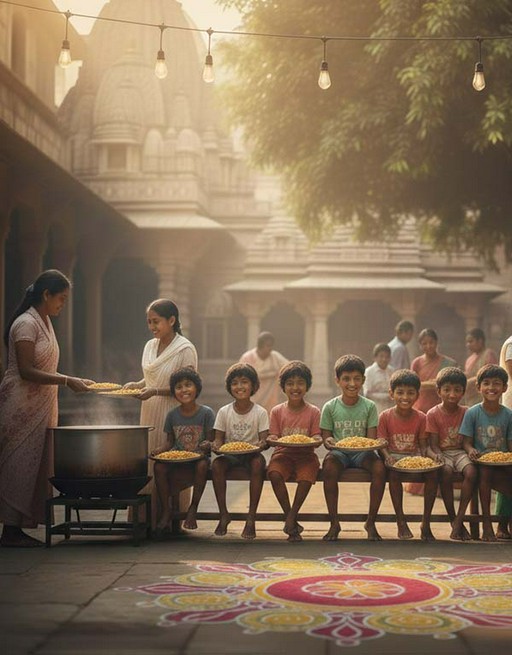
Annapurna Puja
"Annapurna is the Mother who feeds the whole world. Her name means the one who is full of food and plenty. She is a form of Mata Parvati and the queen of Kashi. Tradition tells that Lord Shiva himself begged food from her hands. She holds a golden ladle and a bowl that never runs empty. People say no one in her city of Kashi goes hungry. Her worship brings plenty to the home and steady work to its people. It removes the fear of want and the worry of empty days. Devotees seek her for a life that is full and secure. Her grace keeps the kitchen warm and the family fed."
Pipal Tree Puja
"The Pipal tree is the most sacred tree in Hindu tradition. The Bhagavad Geeta calls it the Ashwattha, the tree under which Lord Krishna himself stands. Tradition holds that the gods reside in different parts of the Pipal. Lord Vishnu lives in its trunk. Lord Brahma lives in its roots. Lord Shiva lives in its leaves. The tree is also the form in which Shani Dev is said to be most easily worshipped. Devotees circumambulate the Pipal seven times, tie sacred threads, and offer water at its roots. The tree is one of the few in the world that releases oxygen even at night. Hindu tradition has worshipped it for thousands of years."
Tripindi Shraddh Puja
"Tripindi Shraddh is a special rite from the shastras. It is meant for ancestors whose last rites were left undone. When a death goes without proper shraddh, the soul stays restless. This unrest can carry on for three generations. It then shows as Pitra Dosha in the family line. The dosha blocks marriage, children, health, and growth. Tripindi Shraddh settles the debt of all three generations at once. The word tripindi points to these three layers of ancestors. The rite gives them rest and lifts their grace upon the family. Kashi is held the best place on earth for this puja."
Durga Puja
"Maa Durga rides a lion. She holds eighteen weapons in her many arms. Each weapon is a gift from a different god. Her gaze is the gaze of a mother who will let nothing harm her children. The demon Mahishasura had a boon. No man, no god could kill him. He defeated even Indra. The gods released their combined energies. From that fire, Maa Durga emerged. After nine days of battle, on the tenth day, she slew Mahishasura. That day is Vijayadashami."
Kuber Puja
"Kuber is the treasurer of the gods. The keeper of all wealth in the universe. He once did severe penance to Lord Shiva and was rewarded with the duty of guarding the treasures of the cosmos. He lives in Alaka, the legendary city of gold in the Himalayas. Lakshmi Mata brings wealth into a home. Kuber makes sure it stays. This is the puja for stable, protected, lasting wealth."
Shiv Rudrabhishek Puja
"Shiv Rudrabhishek is one of the oldest forms of Shiva worship. The Shivling is bathed with eleven sacred substances. Milk for purity. Honey for sweetness. Curd for prosperity. Ganga jal to clear past karma. Then ghee, sugar, rose water, sandalwood paste, panchamrit, coconut water, and bhasma. Each one carries its own meaning."
New Year Puja and Yajna
"The Hindu New Year begins in the month of Chaitra. Its first day is known as Gudi Padwa or Ugadi. Tradition holds that Lord Brahma made the world on this day. It is one of the most blessed starts in the whole calendar. This puja calls on Lord Vishnu, the keeper of the world. It seeks his grace for the whole year ahead. A good start is said to shape the whole year. The yajna carries the prayer for plenty and peace through fire. Families begin the year with worship and not with worry. They ask for success in every task of the coming months."
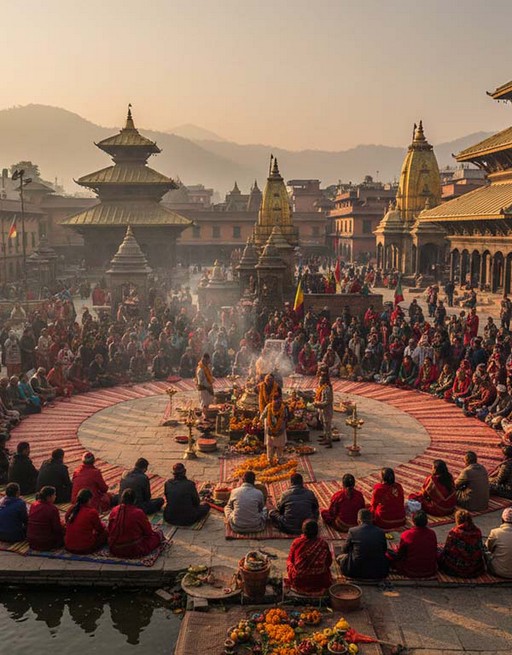
Pashupatinath Group Puja At Kathmandu
"Pashupati means the lord of every pashu, every bound soul that breathes. His temple stands on the banks of the Bagmati in Kathmandu, and it is the guardian deity of Nepal itself. The lingam here is unlike any other. A mukhalinga with five faces, four looking to the four directions and the fifth, Ishana, gazing skyward. Tradition ties this shrine directly to Kedarnath. When Shiva took the form of a bull and dove into the earth, his hump remained at Kedarnath, and his head emerged here, at Pashupatinath. Darshan of both is held to complete the worship. Tradition also holds that the grace of Pashupatinath frees the soul from rebirth in lower forms."
Navgrah Shanti Puja
"Every life is shaped by nine celestial forces. Surya, Chandra, Mangal, Budh, Guru, Shukra, Shani, Rahu, and Ketu. These are not distant stars. In Vedic tradition, they are living divine forces. At the moment of birth, their position imprints itself on the soul. That imprint is the birth chart. When the planets are favourably placed, life flows. When they fall into difficult positions, the devotee senses something is out of sync."