
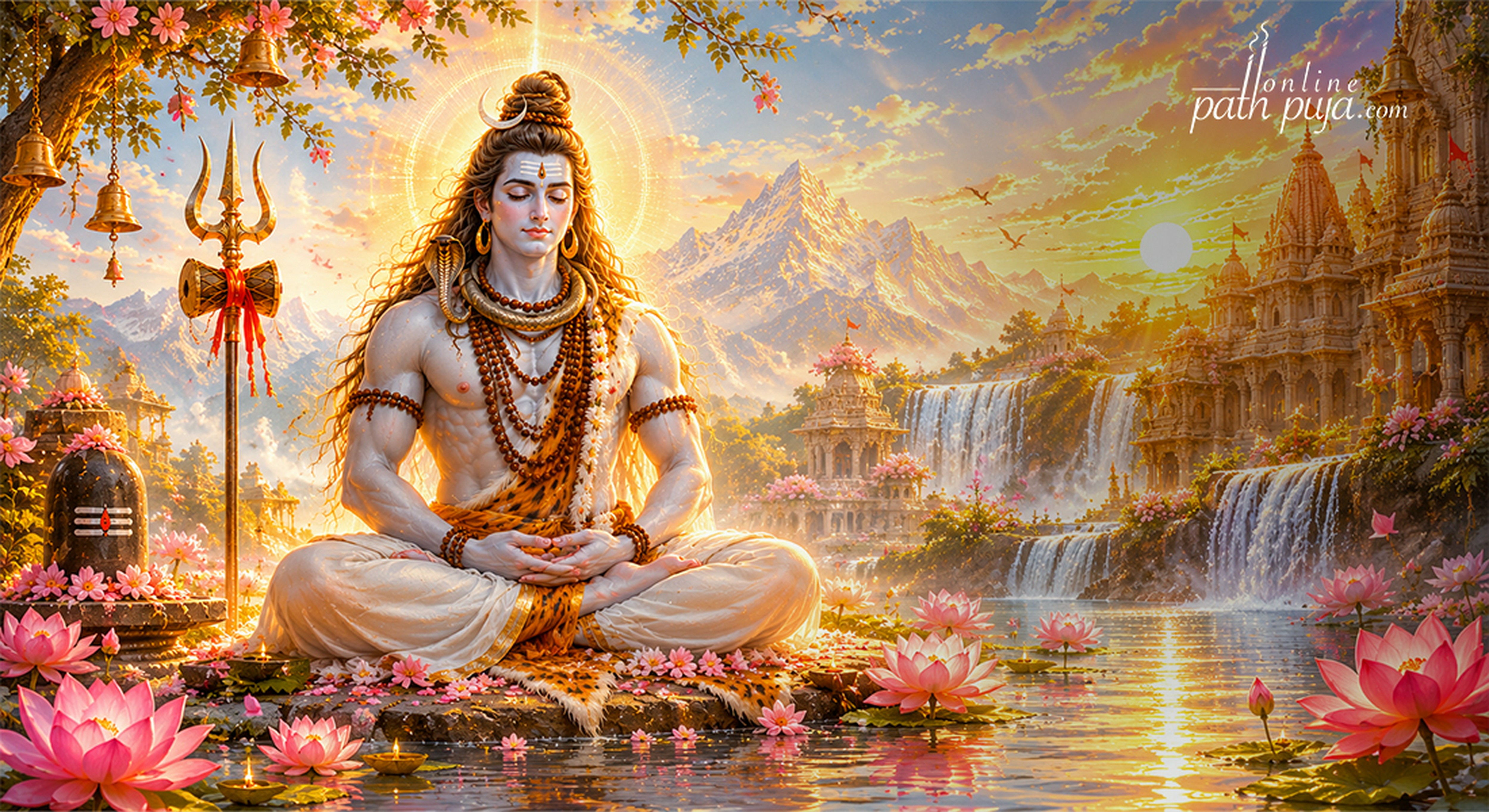
Lord Shiva: The Lord of the Universe, Aughaddani, and Restorer of Creation
When nothing existed, He existed. When nothing will remain, He will still remain. He is the Void, and the Void itself is Lord Shiva. Yes, the literal meaning of the word Shiva is Shunya, the void. It is believed that Lord Shiva himself arose from this very void. When nothing existed in creation, a great Yogi sat in deep meditation within a pillar of divine light, formed from the eternal forces of nature. He was Swayambhu, meaning self-born, and this supreme ascetic was none other than Lord Shiva himself, immersed in tapasya since time without beginning. Everything in the universe arises from the void and ultimately dissolves back into it. To dissolve into the void is to merge with Shiva.
Where and How Was Lord Shiva Born?
The Birth of Bhole Baba According to the Puranas
Several Puranas describe the origin of Lord Shiva in different ways. One Purana mentions that Shiva was created by Brahma, while another says he emerged from Vishnu. According to the Shiv Mahapuran, the mother of the trinity (Brahma, Vishnu, and Mahadev) is Tridev Janani Adishakti, the eternal Prakriti, and the father is Kaal Brahma.
The Vishnu Mahapuran narrates that when Brahma desired a son, he undertook severe penance. Suddenly, a crying child appeared in his lap, and this child was none other than Shiva himself. Since the child's weeping would not stop, Brahma named him Rudra, meaning "the one who weeps."
So while different Puranas describe varying accounts of Shiva's birth, scholars unanimously agree that Bhole Baba is Swayambhu, self-manifested, immersed in eternal meditation, with neither beginning nor end.
Who Are Bhole Baba's Mother and Father?
The proof of Shiva being Swayambhu was given by Narad Muni himself during Shiva's wedding to Parvati. He told Parvat Raj Himalaya that Shiva has no mother, no father, no lineage, and no inheritance. Shiva is Swayambhu. He has created himself. He is Adi Yogi, having merged the entire existence of creation into his own being. Shiva came into existence through the union of Adishakti, Shunya, and Prakriti, a divine vibration known as Omkar.
Why Is Shiva Called the Adi Yogi?
It is believed that Shiva has been immersed in meditation since time immemorial, which is why he is called Adi Yogi, the first Yogi. He possessed the knowledge of yoga from the dawn of time and is considered the world's first yogi, who taught humanity how to sustain life even in the most adverse circumstances through yoga sadhana.
According to the Shiv Mahapuran, Mahadev first imparted the knowledge of yoga to Goddess Parvati. While introducing her to her own latent powers, he revealed to her the foundational sutras of Gyan Yoga and Tantra Yoga. It is believed that Lord Shiva gave Parvati a total of 112 meditation sutras, which encompassed various branches of yoga including Tantra Yoga and Hatha Yoga. For this reason, Mahadev is also called the father of yoga.
Later, while residing in the Himalayas, Lord Shiva passed this yogic wisdom to the Saptarishis (the seven sages), who then carried the knowledge of yoga sadhana to humanity.
Is Mahadev Truly the Destroyer of the Universe?
Creation arose from Brahma. The preservation of creation is overseen by Vishnu. And Mahadev is regarded as the destroyer of creation. But "destruction" here actually means dissolution into the void. The end of existence is the very cause of new creation. Endings are the first stage of creation. "Antah Asti Prarambhah", meaning within every ending lies a new beginning. This is why Bhole Baba is rightly called the god of renewal and regeneration. Shiva is not merely the destroyer. He is the god of new creation.
Shiva as the Creator
The Puranas describe that Lord Vishnu emerged from the tenth limb of Lord Shiva. After Vishnu's manifestation, streams of water flowed from him, submerging all of creation. Vishnu then made his abode in these waters, which is why he is said to reside in the Kshir Sagar (the Ocean of Milk). From Vishnu's navel arose a lotus, on which Brahma was born. Spiritually, therefore, Shiva himself is the deity of creation.
The Avatars of Lord Shiva: 19 Main Avatars and 11 Rudra Avatars
Beloved by devotees as Umapati, Shiv Shankar, Aughaddani, Bhole Baba, Bhola Bhandari, and Mahadev, this compassionate Lord descended on Earth many times, always with a profound purpose. The Shiv Mahapuran and Linga Puran describe Shiva's avatars in great detail. According to these texts, Bhole Baba has 19 miraculous avatars and 11 Rudra avatars. The Tantra Shastra also mentions the Dashavatar of Shiva.
The 19 Main Avatars of Bhole Baba
Veerbhadra Avatar. After Sati's self-immolation, an enraged Shiva tore a lock of hair from his head and flung it on a mountain, from which Veerbhadra emerged.
Pippalad Avatar. Lord Shiva incarnated as Pippalad, the son of Maharishi Dadhichi. Those afflicted by Shani Dasha find relief by simply remembering Pippalad.
Nandi Avatar. According to Shiv Puran, Shiva's devotee Shilad asked for an immortal, ayonija (not born from a womb) child. As a result, while plowing the earth, he was blessed with Nandi.
Bhairav Avatar. Bhairav is said to have manifested from Shiva's blood during a moment of intense rage. In his fury, Bhairav severed Brahma's fifth head.
Ashwatthama. During the Mahabharata era, Guru Dronacharya performed severe penance to receive Shiva as his son. Pleased by this, Shiva blessed him and was born in his home as Ashwatthama.
Sharabh Avatar. When Lord Vishnu's wrath in his Narasimha form could not be pacified, Shiva took the Sharabh Avatar to calm him. In this form, he appeared as half-deer, half-lion, with elements of a man and the mythical Sharabh bird.
Grihapati Avatar. When sage Vishwanar worshipped the Viresh Lingam in Kashi, he saw a child in the linga. He worshipped this child-form of Shiva and was blessed with him as a son.
Rishi Durvasa. Born to Mata Anusuya through her devotion to the Trimurti, Durvasa was an avatar of Bhole Baba.
Mahabali Hanuman. According to the Shiv Mahapuran, Bajrangbali (Mahabali Hanuman) is considered an ansh (part) of Shiva. The Saptarishis placed Shiva's energy into Mata Anjani's womb through her ear, and from this union, Hanuman was born.
Vrishabh Avatar. When Vishnu's sons caused chaos in the netherworld, Shiva took the form of Vrishabh (a bull) to subdue them.
Yatinath Avatar. Shiva incarnated as Yatinath in the home of the great devotee couple Aahuka and his wife, who had given their lives in the service of guests.
Krishna Darshan Avatar. In the ninth generation of Ikshvaku-clan Shraddhadeva, Shiva took the Krishna Darshan Avatar. During this incarnation, he taught humanity the importance of yajna and religious rituals.
Avadhoot Avatar. To shatter Indra's pride, Shiva manifested as the Avadhoot.
Bhikshuvarya Avatar. Shiva took the form of a beggar to inspire a beggarwoman to raise the son of Vidarbha's king Satyarath.
Sureshwar Avatar. Pleased by the devotion of Upamanyu, son of Vyaghrapad, Shiva manifested as Sureshwar.
Kirat Avatar. During the Mahabharata era, Shiva took the Kirat (hunter) form to save Arjuna from the demon Mooka.
Brahmachari Avatar. After Sati's departure, when Parvati was performing penance to win Shiva, he appeared as a Brahmachari to test her devotion.
Sunatnartak Avatar. To ask for Parvati's hand from her father, Shiva appeared as a dancer (Nat) with a damaru in hand. This form is known as the Sunatnartak Avatar.
Yaksha Avatar. To humble the gods' arrogance after the consumption of amrita, Shiva incarnated as a Yaksha.
The 11 Rudra Avatars of Shiva
Another name for Lord Shiva is Rudra, the one who destroys sorrow. It is believed that countless Rudra forms of Shiva are present throughout the three worlds. However, eleven specific Rudra avatars dwell with Shiva on Mount Kailash to this day. The Shiv Mahapuran contains the following verse:
Ekadashaite Rudrastu Surabhitanayaa: Smritaa: | Devakaryarthamutpannashshivaroopassukhaaspadam ||
This verse reveals that the eleven Rudras are sons of Surabhi, born from Shiva's form to accomplish the work of the gods.
The eleven Rudra avatars are:
- Shambhu
- Pinaki
- Girish
- Sthanu
- Bharg
- Bhav
- Sadashiv
- Shiv
- Harr
- Sharv
- Kapali
Why Is Lord Shiva Different from Other Deities?
The Adi Dev Mahadev, who has neither beginning nor end, possesses qualities that defy complete description. While all other deities appear richly adorned in jewels and ornaments, Bhole Baba wears only the skin of elephants and tigers. His only ornament is the Rudraksha. He is always surrounded by forbidden objects, ghosts, spirits, and fearsome ganas. Yet behind this appearance lies Bhole Baba's infinite divine play. Every object he wears carries a deep purpose for the welfare of humanity.
According to the Linga Puran, Mahadev is adorned with 16 sacred qualities, each symbolizing a profound message for humankind.
The 16 Sacred Symbols of Lord Shiva
Bhasma (Sacred Ash). His ash-smeared body symbolizes the rebirth of creation. Everything, when burnt, turns to ash, which is why Baba loves the bhasma abhishek. According to some beliefs, Shiva, having accepted his devotee in life, accepts the devotee's ash-form even after death, wearing it as a symbol of this eternal bond.
Jataa (Matted Hair). The three locks on Shiva's head represent physical, mental, and spiritual energy.
Ganga. When we picture Shiva, the Ganga flowing from his matted hair appears inseparably before our eyes, symbolizing purity and divine grace.
Crescent Moon (Ardhachandra). Worn on his head as one of his ornaments, the crescent moon symbolizes the cyclical nature of time.
Trinetra (Third Eye). Shiva is called Tryambak Dev, the three-eyed god. The third eye represents spirituality and supreme wisdom.
Half-Open Eyes. Shiva's eyes are always half-open, symbolizing his yogic state that is neither asleep nor awake.
Kundal (Earrings). Shiva wears two different earrings in his ears, representing the masculine and feminine principles.
Serpent Around His Neck. The snake worn as an ornament symbolizes Shiva's yogic power.
Vasuki Naag. Coiled three times around his neck, Vasuki symbolically represents the cycle of past, present, and future.
Rudraksha. It is said that when Shiva opened his eyes after emerging from yoga, a few tears fell to the earth. Wherever they fell, Rudraksha trees sprouted. Shiva himself wears the Rudraksha mala.
Varad Mudra (Boon-Granting Posture). Shiva is always seen in the boon-granting posture, which is why he easily grants boons to gods, demons, humans, and all beings alike.
Trishul (Trident). His three-pronged weapon represents Ichcha (desire), Kriya (action), and Shakti (power).
Damaru. The two-headed drum in Shiva's hand produces the sound of the universe, the source of the primordial Nada Brahma.
Kamandal. The water vessel that always accompanies Shiva.
Nandi. Shiva's vahana (vehicle) and constant companion, symbolizing Dharma.
Tiger Skin and Cremation Ground. Shiva is always seated on a tiger skin, symbolizing creative energy. He also dwells in cremation grounds, representing the eternal cycle of birth and death.
How Did Lord Shiva and Mata Parvati Get Married?
Mata Parvati's Severe Penance
After Sati left her body, Shiva wandered the universe carrying her burning body, and his grief began to destroy all of creation. In this sorrow, he entered a deep meditation and waited for Adishakti for many ages.
According to the Puranas, Adishakti took 107 births trying to attain Shiva as her husband, but she failed each time. Finally, she was born as Parvati, daughter of King Himavan and Mainavati. Parvati performed 14,000 years of penance to win Shiva, and only then did Adishakti finally reunite with her eternal Lord.
A Wedding Unlike Any Other
The wedding of Shiva and Parvati was unlike any other. It took place on the Chaturdashi of the Krishna Paksha in Phalguna, the day we now celebrate as Mahashivratri. The wedding procession (baraat) included the smallest and the greatest of beings. Gods and demons walked together. Ghosts and spirits danced along the way. Even insects, animals, and crawling creatures were invited with equal reverence.
Mata Mainavati's Refusal
During the wedding, Shiva sat silently, gazing into the void. He showed no excitement or interest in his bride. Shocked by his appearance, Himavan and Mainavati initially refused to marry their daughter to him. Parvati then humbly requested Shiva to dress as a proper groom. Shiva graciously accepted, and all the gods together adorned him. When he finally appeared at the wedding venue in his divine groom form, the bride's family accepted him, and the cosmic wedding was completed in the presence of the entire universe.
The Wedding Fire Still Burns Today
Shiva and Parvati's wedding took place at Triyugi Narayan Temple in Rudraprayag, Uttarakhand, nestled in the lap of the Himalayas. To this day, the sacred fire lit for their wedding pheras continues to burn in this temple.
Where Does Bhole Baba Live?
The Home of the Aughaddani
Lord Shiva is the only deity who chose to dwell on Earth itself. He resides at Mount Kailash and in the holy city of Kashi (Varanasi). Kailash was Shiva's own choice. Kashi was where he settled at the prayer of Kuber. At both these places, Shiva is present in his living, sagun form to this day.
Shiva's Divine Family
Bhole Baba is the only deity who has a complete, happy household. His family includes his wife, sons, daughter, daughters-in-law, grandchildren, ganas, and animals.
- Head of the family: Lord Shiva himself, the supreme father.
- Mother: Goddess Parvati, the mother of the divine family.
- Kartikeya Swami: Their elder son, commander of the celestial armies.
- Lord Ganesha: Their younger son, the first to be worshipped among all gods.
- Ashoka Sundari: Shiva's daughter, mother of King Yayati and a hundred beautiful daughters.
- Daughters-in-law: Ganesha's two wives, Riddhi and Siddhi.
- Grandsons: Ganesha's sons, Kshem and Labh, known together as Shubh-Labh.
- Ganas: Shiva's friends and protectors include Bhairav, Veerbhadra, Manibhadra, Chandresh, Nandi, Jaya, Vijaya, Kartik, Kuber, Kirtimukh, and Sarp.
- Nandi: The sacred bull, both vehicle and family member.
His family also includes a mouse, snake, peacock, and lion, symbolically conveying the message of harmony among all beings.
Shiva: The Universe's First Dancer, Yogi, Musician, and Singer
Bhole Baba is the first guru of music, dance, singing, instrumental playing, and yoga. Since he appeared first in the universe, it was Shiva who introduced humanity to all these divine arts. His Nataraja form is the supreme proof that dance was his greatest love.
When pleased, he would perform the Tandava with his damaru, spreading bliss across the cosmos. When angered, he would dance the Tandava without the damaru, filling the universe with awe and fear. To this day, Nataraja statues are installed as the presiding deity in dance halls across the world.
Why Is the Shivling Worshipped?
The Shivling is the form in which Mahadev is worshipped on Earth. The Sanskrit word linga means "symbol" or "mark." Therefore, Shivling literally means "the symbol of Shiva." Worship of the Shivling is even mentioned in the Samaveda, where it is referred to as a divine pillar.
How Did the Shivling Manifest?
The Shiv Mahapuran tells that once Brahma and Vishnu were arguing over who was greater. Suddenly, a divine pillar of infinite light appeared before them. They decided that whoever could find the end of this pillar would be declared supreme. Both gods searched in their own directions, but after ages of effort, neither could find the beginning or the end. Inside this pillar, Shiva himself was meditating, and the pillar was none other than the infinite Jyotirlinga, the original Shivling, without beginning or end.
The Shivling is worshipped in many forms. There is the Parthiva Shivling made of clay, the Jyotirlinga at sacred sites, and the Narmadeshwar Shivling, where every stone of the holy Narmada river is naturally consecrated and can be worshipped without any pran-pratishtha ritual.
The Twelve Jyotirlingas
There are twelve Jyotirlingas of Lord Shiva across the cosmos, known as the Dwadash Jyotirlinga:
- Somnath in Saurashtra, Gujarat
- Mallikarjuna in Shrishailam, Andhra Pradesh
- Mahakaleshwar in Ujjain, Madhya Pradesh
- Omkareshwar in Khandwa, Madhya Pradesh
- Vaidyanath in Parli, Jharkhand
- Bhimashankar in Khed, Maharashtra
- Rameshwaram in Setubandh, Tamil Nadu
- Nageshwar in Dwarka, Gujarat
- Vishweshwar (Kashi Vishwanath) in Varanasi, Uttar Pradesh
- Trimbakeshwar in Nashik, Maharashtra
- Kedarnath in the Himalayas, Uttarakhand
- Grishneshwar in Aurangabad, Maharashtra
The Mystery of Shiva's Blue Throat and the Tradition of Offering Water
How the God of Gods Became Neelkanth
During the Samudra Manthan (the churning of the ocean), the deadly poison Halahal (also called Kaalkoot) emerged from the sea. As it began to spread, it threatened to destroy all of creation. No one had the power to contain it. The gods then prayed to Shiva, who drank the Halahal and held it in his throat. As a result, his throat turned blue, earning him the name Neelkanth. From this moment, he was also called Mrityunjaya, the conqueror of death. By saving the entire universe through this sacrifice, Shiva came to be known as the God of Gods (Devon Ke Dev).
To ease Shiva's pain from the poison, all the gods began pouring milk and water over him. This is why pouring milk and water on the Shivling is believed to win his special grace.
How to Please Bhole Baba
Offer His Beloved Items
Bhole Baba, the eternally boon-granting Bhola Bhandari, is so simple to please that a single pot of water is often enough. Still, a few of his beloved offerings make his grace flow even more abundantly:
- A pot of water mixed with a little milk, Gangajal, akshat (rice), and bilva leaves, poured over the Shivling, is believed to fulfill all the devotee's wishes.
- Bhole Baba loves bhasma (sacred ash). Offering it on the Shivling pleases him quickly.
- He does not demand exotic flowers. The simple white Aak (Madar) flower delights him. He also loves dhatura flowers and shami flowers.
- He is fond of bilva leaves and dhatura fruit.
- His favorite color is white. Offering white items invites his easy grace.
Bhole Baba's Bhog (Sacred Offering)
To please Bhole Baba, no 56-course feast is needed. He is satisfied with simple offerings of sugar and wheat flour prasad. He is also fond of bhang.
To remember him, no elaborate ritual is required. The simple chant of "Om Namah Shivaya" is enough.
The Significance of Monday (Somvar)
Monday is Bhole Baba's favorite day, dedicated to Chandra Dev. This is why Shiva is also called Someshwar. When Chandra Dev performed severe penance to be freed from a curse, Shiva accepted his Shivling, named it Someshwar, and wore the moon on his own head. He blessed Chandra Dev with this promise: any devotee who bathes early on Monday and pours water on Bhole Baba will receive his special grace.
The Sacred Month of Shravan
Shravan is Bhole Baba's most beloved month. It is believed that during Shravan, he visits his in-laws' home on Earth, making him most accessible to devotees. Worshipping every Monday of Shravan is the easiest path to his special grace.
The Shiv Tandav Stotra by the Supreme Devotee Ravana
A devotee can quickly please Shiva simply by singing the Shiv Tandav Stotra, composed by his greatest devotee, Ravana. Yes, Ravana is regarded as Shiva's most honored devotee, and his composition remains one of the most powerful hymns of welfare to this day.
Service to Nandi
Serving Nandi quickly pleases Bhole Baba. Nandi is not just Shiva's vahana but also his greatest devotee. When the Halahal poison was being consumed, a few drops fell on the ground, and Nandi licked them up. Pleased by this act, Shiva declared Nandi his foremost devotee and proclaimed that whoever serves Nandi shall surely receive his grace.
The Puranas declare that no one can defeat Shiva by force. Only bhakti (devotion) is the path through which one can fully attain him.
Pujas Dedicated to Bhole Baba
In Kaliyuga, merely remembering Bhole Baba is said to grant liberation. Yet certain special pujas invite his particular grace:
Rudrabhishek is Bhole Baba's most beloved puja. Devotees chant Om Namah Shivaya while offering milk, curd, ghee, honey, sugarcane juice, mustard oil, bilva leaves, akshat, bhang, dhatura, betel leaf, and white sandalwood tilak on the Shivling.
Lingashtak is a special shloka sung during Shiva worship that brings immense blessings.
Shivratri Vrat. Observing the fast and worship on Shivratri quickly invokes Shiva's grace.
Sixteen Mondays Vrat (Solah Somvar). Mata Parvati observed 16 Mondays of penance to attain Shiva as her husband. This vrat brings physical and mental health, and unmarried girls are believed to be blessed with their desired husband.
Shravan Somvar Puja. Each Monday of the holy Shravan month is auspicious for Shiva puja.
Rudrashtak is a melodious hymn that pleases Shiva. The sweeter it is sung, the more pleased he becomes.
Special Mantras for Bhole Baba's Grace
Panchakshar Mantra: "Om Namah Shivaya" is the five-syllabled mantra representing the five elements of the earth. This is the easiest way to please Bhole Baba.
Rudra Mantra: "Om Namo Bhagavate Rudraya Namah" fulfills all desires of the chanter.
Mahamrityunjaya Mantra:
Om Haum Joom Sah Om Bhurbhuvah Swah Om Tryambakam Yajamahe Sugandhim Pushtivardhanam Urvarukamiva Bandhanan Mrityormukshiya Maamritat Om Swah Bhuvah Bhuh Om Sah Joom Haum Om
This mantra is believed to free the chanter from the fear of untimely death.
How to Learn More About Bhole Baba
To explore more about Lord Shiva, his role in the welfare of gods, and his contributions to humanity, the curious seeker can read the Shiv Mahapuran, Linga Mahapuran, Shvetashvatara Upanishad, Mandukya Upanishad, Kaivalya Upanishad, Atharvashikha Upanishad, and Sharabh Upanishad.
The television series "Devon Ke Dev Mahadev", telecast after deep research, beautifully portrays the life of Shiva. Mohit Raina, with his calm and graceful presence resembling Mahadev himself, earned a permanent place in viewers' hearts through this iconic role.
Frequently Asked Questions About Lord Shiva
Q1. How did Bhole Baba take birth on Earth?
Bhole Baba is Swayambhu, which means self-manifested. He has been immersed in penance on Earth since time immemorial. According to the Puranas, before creation, nothing existed (neither truth nor untruth). Only the formless Shiva pervaded everything. Shiva is unborn.
Q2. Where does Bhole Baba reside?
On Earth, Bhole Baba dwells in his living form at Mount Kailash and Kashi.
Q3. Who is Bhole Baba's mother?
According to the Shiv Mahapuran, his mother is Adishakti, also called Tridev Janani, the mother of the trinity. The Devi Bhagavat (third skandha) also mentions Brahma's praise of Adishakti, who is said to be the source from which Brahma, Vishnu, and Mahesh manifested.
Q4. Who is Bhole Baba's father?
Kaal Brahma is said to be Shiva's father. The Vishnu Puran narrates that Brahma performed penance to receive Shiva as his son, and Shiva manifested as the child Rudra in his lap. A beautiful verse from the Vishnu Puran states:
Srishtisthityantakaraneem Brahmavishnushivatmikam | Sa Samjnam Yati Bhagavan Eka Eva Janardanah ||
This means: Vishnu himself, as Brahma, creates the universe. As Vishnu, he preserves it. As Shiva, he dissolves it.
Q5. Why is Mahadev called the God of Gods?
During the Samudra Manthan, the deadly Halahal poison emerged, and no deity had the power to contain it. Only Mahadev drank it and held it in his throat. For this great sacrifice, he earned the title Devon Ke Dev.
Q6. Why is Mahadev's throat blue?
After consuming the Halahal, Shiva neither swallowed it (to protect Lord Ram, who he believed dwelt in his heart) nor spat it out (to protect the universe). Instead, he held it in his throat, which turned blue from the poison.
Q7. Which god can defeat Lord Shiva?
No being can defeat Shiva through strength alone. The Puranas describe several battles between Shiva and other gods, but none ever defeated him. This is because all the gods are complementary to one another.
Q8. How many ages did Shiva wait for Parvati?
Lord Shiva waited for Mata Parvati for several yugas (ages).
Q9. Why did Shiva show his Ardhanarishwar form to Brahma?
Shiva revealed his Ardhanarishwar form to inspire Brahma to create reproductive beings, so that creation could continue through the union of masculine and feminine energies.
Q10. What is the name of Shiva's bow?
Shiva's bow is called Pinak. It is considered the most powerful bow in the universe. With it, Shiva slew the demon Tripurasura.
Q11. Where can a seeker find Bhole Baba?
Bhole Baba pervades every particle of the universe. Shivah Sarvam means Shiva is everything, everywhere. However, to feel his divine proximity, a seeker may visit Mount Kailash and Varanasi.
Q12. Who was Shiva's supreme devotee?
While devotion cannot truly be compared, Kannappa is often called Shiva's supreme devotee. He offered his own eyes to stop the bleeding from the Shivling's eyes.
Q13. What are Bhole Baba's favorite leaves and flowers?
Aak (Madar) flowers and bilva leaves are his most beloved offerings.
Q14. What is the simplest way to please Bhole Baba?
Walking the path of righteousness with unwavering faith in him. Even offering only water and bilva leaves invites his grace.
Q15. What is Bhole Baba's favorite color?
White (Shvet) is considered his favorite color, the color of purity.
Q16. Why is Mahadev called Bhole Baba?
Mahadev is the only deity who is truly innocent at heart. He sees only the devotion of his devotee, never their intent. Because of this innocent nature, he often granted boons even to demons.
Q17. What is the name of Bhole Baba's daughter?
According to Shiv Puran, his daughter is Ashoka Sundari. The Linga Puran also describes five Nag-Kanyas as his daughters. On the Shivling, the upper part is associated with the five Nag-Kanyas, and the serpent figure in the middle of the jaldhari represents Ashoka Sundari.
Q18. What does "Om Namah Shivaya" mean?
It means: "I surrender my soul to Lord Shiva."
Q19. How many disciples did Lord Shiva have?
The entire universe learns from Shiva, but originally he had seven disciples, the Saptarishis:
Vasishthakashyapo'trirjamadagnissagautamah | Vishwamitrabharadwaajau Sapta Saptarshayobhavan ||
Vasishtha, Kashyap, Atri, Jamadagni, Gautam, Vishwamitra, and Bharadwaj are the seven sages who were Shiva's disciples.
Q20. On which days and festivals should Shiva be worshipped?
Shiva is worshipful at every moment, but Mondays, Pradosh days, the entire Shravan month, monthly Shivratri, and Mahashivratri are especially auspicious. According to Vedic astrology, Shivvas (Shiva's location at a given muhurta) is traditionally considered before worship. However, this is not required during Shravan, Adhik Maas, or at Kashi and the Jyotirlingas.
Q21. In which cave did Shiva impart wisdom to Parvati?
According to the Shiv Mahapuran, Shiva gave the knowledge of 112 meditation sutras to Parvati in the Amarnath Cave.
Q22. Where did Shiva hide from Bhasmasura?
Shiva created a cave using his trident in the Trikuta Hills to escape Bhasmasura.
Q23. How is Bhole Baba's wedding day celebrated?
Shiva and Parvati's wedding took place on Mahashivratri, celebrated across the universe with great joy.
Q24. Why is Shravan called Mahadev's favorite time?
During Shravan, Mahadev is said to visit Earth as a guest at his in-laws' home. He is closest to humanity during this time, which is why Shravan is his most beloved month.
Q25. Why are dhatura and bhang offered to Shiva?
When the Halahal's effects could not subside and Shiva began to suffer, the gods placed dhatura and bhang on his forehead and continuously performed jal-abhishek. In Ayurveda too, dhatura and bhang are recognized for their power to neutralize poison.
Q26. Why is Shiva called "Har Har Mahadev"? Why is "Har" said twice?
The word Har has two meanings. One is Shiva himself, and the other means "to take away." Saying Har twice is therefore a prayer. It is asking Shiva (Har) to take away (har) the devotees' worldly suffering.
Q27. What happens when the name "Mahadev" is chanted twice?
Mahadev Mahadev Mahadeveti Yo Vadet | Ekena Muktimapnoti Dvabhyam Shambhu Rini Bhavet ||
This means: Whoever chants "Mahadev" even once is granted liberation. Chanting it a second time makes Mahadev himself indebted to the devotee.
Q28. What is Shiva's Panchmukhi form?
The Vishnu Puran tells that once Vishnu took the form of a charming young man, and all the gods praised him with their many mouths. Seeing this, Shiva thought, "If I too had many faces and eyes, I could behold Vishnu's beauty completely." With this thought, Shiva took the Panchmukhi (five-faced) form, and is also called Panchanan.
The Shiv Puran also describes that his five faces represent the five cosmic functions: Srishti (creation), Palan (preservation), Samhar (dissolution), Tirobhav (concealment), and Anugraha (grace). The names of the five faces are Aghor, Sadyojat, Tatpurush, Vamdev, and Ishan.
Q29. How is Shiva's family arranged on the Shivling's jaldhari?
On the left side of the jaldhari sits Kartikeya. On the right sits Ganesha. The serpent figure in the middle represents Ashoka Sundari. The base just below the Shivling is the Hastakamal, representing Mata Parvati. The top of the Shivling holds the five Nag-Kanyas.
Q30. What is another name for the poison Shiva consumed?
The other name for the Halahal poison is Kaalkoot.
May Bhole Baba bless all of humanity and shower his eternal grace upon them.